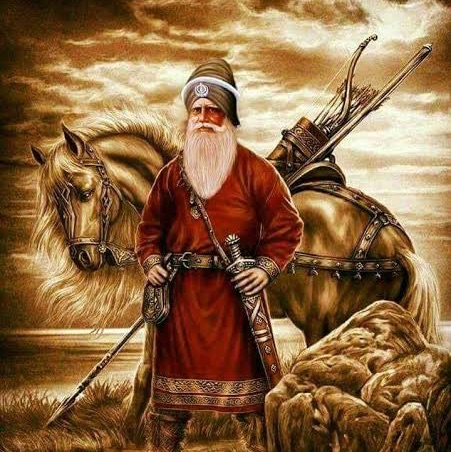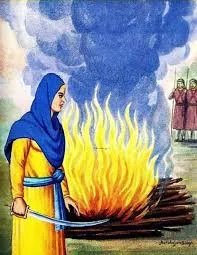
Heartfelt congratulations on the birth anniversary of Bhagat Ravidas Ji. Let us take a look at his life and history. Bhagat Ravidas Ji was born on the 19th day of the month of Magh in the year 1377 CE at Seer Govardhanpur, near Banaras (Kashi) in present-day Uttar Pradesh. His father’s name was Santokh Das Ji, and his mother’s name was Kalasi Devi Ji. His wife was Mata Lona Ji, and his son was Vijay Das Ji. Some other important details related to the life of Bhagat Ravidas Ji are as follows. His grandfather’s name was Kalu Ji, and his grandmother’s name was Lakhpati Ji. His clan (gotra) was Jassal. He was born into the Chamar community, and his father’s ancestral occupation was leather work. Bhagat Ravidas Ji met Guru Nanak Dev Ji in Kashi (Banaras) at Gopaldas Sarai, the place where Gurdwara Guru Ka Bagh stands today. Among his contemporaries were Bhagat Kabir Ji, Sant Ramanand Ji, Raja Pipa, Bhagat Sain Ji, Bhagat Dhanna Ji, Bhagat Bhikhan Ji, and Bhagat Beni Ji. The prominent followers and devotees of Bhagat Ravidas Ji included Meera Bai, Jhala Bai, Rani Ratan Kunwar, Raja Nagar Mal, Raja Pipa, Raja Bahadur Shah, Sultan Sikandar Lodi, Raja Chandrahans, Raja Sanga, Pandit Shraddha Ram, Ram Lal, Raja Bain Singh, Pandit Ganga Ram, Bibi Bhanmati, and Raja Chandra Pratap. Bhagat Ravidas Ji was imprisoned twice—once in Delhi, in the prison of Sikandar Lodi, and the second time in Khuralgarh, in the prison of Raja Ben Singh. His well-known blessings and miracles include making stones float, breaking prison chains, guiding a hunter onto the right path, offering a single damri coin, breaking jail locks, appearing seated among learned Brahmins, saving Meera Bai’s life, rescuing Ram Lal from a lion, reviving the son of Pandit Shraddha Ram, and granting divine light to Karma, the daughter of a washerman. Bhagat Ravidas Ji was a devotee of One Supreme God. His name is mentioned in Sri Guru Granth Sahib by Guru Arjan Dev Ji, Guru Ram Das Ji, and Bhatt Kal Sahar Ji. During that era, Shudras were forbidden from receiving education, entering temples, practicing devotion openly, visiting the homes of upper castes, and accessing public spaces such as wells, roads, and grazing lands. Bhagat Ravidas Ji once sent an offering of one damri coin to the River Ganga, and in return, the River Ganga sent him a diamond-studded bracelet. He stayed in Khuralgarh for four years, two months, and eleven days. Khuralgarh is located in present-day Hoshiarpur district of Punjab. At that time, society was divided into four classes: Brahmins, Kshatriyas, Vaishyas, and Shudras. Bhagat Ravidas Ji worked tirelessly to bring social reforms, advocating for the right of Shudras to receive education, promoting equality in society, and demanding access to temples and public places for all. In Kashi, he meditated and practiced devotion under a tamarind tree. The sacred footprints of Bhagat Ravidas Ji are preserved even today under a pavilion outside Meera Temple in Chittorgarh. He was also known by other names such as Raidas, Rohidas, Ruhidas, and Ramdas. Ancient ponds (sarovars) were constructed in his name at Ellora, Hyderabad, Junagadh, and Mandher near Banaras. Bhagat Ravidas Ji envisioned a revolutionary society and city—one without caste discrimination, without high or low status, where everyone could move freely with equal rights, and where jealousy, poverty, sorrow, taxation, and oppression did not exist. He named this ideal city Begampura. One of his most famous verses is: “Har so heera chhod ke, kareh aan ki aas; Te nar dozakh jaahinge, sat bhakhai Ravidas.” Meaning: A person who abandons God, the true diamond, and seeks happiness elsewhere will suffer misery. In Sikh history, the priceless spiritual treasure of Gurus, Bhagats, saints, and prophets is preserved in Sri Guru Granth Sahib. Guru Arjan Dev Ji, during his Guruship, compiled this sacred scripture by including the hymns of the first four Gurus, along with the compositions of 11 Bhattas and devout Sikhs of the Guru’s household. Along with this, he respectfully included the hymns of 15 Bhagats, including Baba Farid Ji, Bhagat Kabir Ji, Bhagat Beni Ji, Bhagat Namdev Ji, Bhagat Trilochan Ji, Bhagat Jaidev Ji, Bhagat Ramanand Ji, Bhagat Sain Ji, Bhagat Sadhana Ji, Bhagat Pipa Ji, Bhagat Dhanna Ji, Bhagat Surdas Ji, and Bhagat Ravidas Ji. The hymns of Bhagat Ravidas Ji include 40 shabads recorded under 16 ragas in Sri Guru Granth Sahib. Beyond these, many of his compositions are also found elsewhere. His writings convey love for God, the Guru, the universe, and nature, and emphasize the welfare of humanity. His devotional philosophy had a deep impact on the Bhakti movement. Bhagat Ravidas Ji strongly condemned the social evils of his time—caste discrimination, untouchability, hypocrisy, ritualism, and inequality—and spread the message of shared humanity. Among the devotees who contributed greatly to social reform alongside devotion to God, Bhagat Ravidas Ji holds a distinguished place. He was a social reformer, humanist, religious thinker, and a great poet. Socially, he belonged to a community that was considered “untouchable,” and whose members traditionally carried dead animals. According to certain orthodox texts of the time, this community was viewed with deep contempt. Bhagat Ravidas Ji was a disciple of Sant Ramanand and a contemporary of Bhagat Kabir Ji. Because of his devotion and opposition to caste pride, he was repeatedly threatened and humiliated. Once, a group of Brahmins collectively ordered him to abandon devotion to God, but he fearlessly declared that God does not belong to any single caste, class, or religion—God belongs to all. Enraged, the Brahmins raised sticks and threatened him with death. This reflects the severe hardships he endured throughout his life. Perhaps for this reason, in his hymns he repeatedly calls upon God as the protector of the oppressed and marginalized. Bhagat Ravidas Ji deeply felt the injustice and discrimination prevalent in society and logically refuted it with reason and spiritual insight. He placed the highest status not on birth or caste, but on devotion to God. He explained that fear, anxiety, poverty, suffering, moral decline, and confusion weaken human beings mentally and push them toward downfall. At the same time, he outlined the path that leads to growth, prosperity, and bliss. He imagined a prosperous society—an ideal city—where there would be no worry of livelihood, no fear of taxation, no oppression by rulers, complete freedom of movement, and no restrictions. In Sri Guru Granth Sahib (Ang 345), he beautifully describes this divine city Begampura, filled with radiant peace and spiritual joy: “Begampura shehar ko naaon, Dukh andoh nahin tihi thaaon; Na tasvees khiraaj na maal, Khauf na khataa na taras jvaal.” Bhagat Ravidas Ji was far ahead of his time. He spoke not of liberation after death, but of liberation while living—not individual salvation, but collective liberation, the welfare of all, the concept of Sarbat da Bhala. He inspired people to change and rebuild social philosophy. During that period, rule by Turks and Pathans had created instability, disorder, and unrest. The Delhi Sultanate had weakened, and despair prevailed among common people. Bhagat Ravidas Ji gave these oppressed and broken people a new dream. Philosophers like Plato and Thomas More envisioned ideal societies that became widely discussed, yet Bhagat Ravidas Ji’s Begampura remains primarily preserved within Sri Guru Granth Sahib. Bhagat Ravidas Ji never felt ashamed of being born into a so-called low caste. Instead, he openly and humbly acknowledged it in his hymns: “Meri jaat kameeni, paat kameeni, ochha janam hamara; Tum sharnagat Raja Ramchand, kahi Ravidas Chamara.” Once, Queen Jhala Bai of Chittorgarh invited Bhagat Ravidas Ji and other Brahmins to her palace for a ceremonial feast. The Brahmins refused to attend because Ravidas Ji had also been invited. It was decided that the Brahmins would eat first and Ravidas Ji later, as they did not accept sitting alongside him. When the Brahmins sat down to eat, each of them saw Bhagat Ravidas Ji eating from his own plate. Chaos erupted, and the Brahmins realized they were witnessing a spiritually elevated saint. They apologized, bowed at his feet, and sought forgiveness. The Queen honored Bhagat Ravidas Ji by seating him on an elephant, holding a royal canopy over his head, and leading a procession through the village. At that moment, Bhagat Ravidas Ji uttered the following hymn in gratitude to God: “Aisi laal tujh bin kaun karai; Gareeb nivaaz Gusaiyaa, mera maathai chhatr dharai.” Meaning: O Lord, it is by Your grace alone that I receive protection, honor, and dignity. Bhagat Ravidas Ji taught that if the heart is pure, there is no need for outward rituals, pilgrimages, or hollow ceremonies. His saying, “If the mind is pure, even a small bowl becomes the Ganga,” clearly conveys this message. He openly opposed casteism, inequality, hypocrisy, and ritualism, and encouraged people to live righteously, perform honest labor, and remain aligned with God’s will. Despite coming from a family with wealth, he never allowed wealth to dominate his principles. He lived a life of detachment and generosity, giving away whatever he had to saints and devotees in need. After marriage, when he was separated from his family, he earned his livelihood by making leather shoes. He had no desire for riches. It is said that once a well-wisher placed a philosopher’s stone (Paras) in his hut to remove his poverty, but when he returned days later, the stone remained untouched, exactly as it had been left. After living for 151 years, Bhagat Ravidas Ji left his physical body in Chittorgarh, merging with the Divine. A grand memorial in his honor still exists there. His teachings continue to guide humanity like a beacon of light. Waheguru Ji Ka Khalsa, Waheguru Ji Ki Fateh.
Please log in to comment.