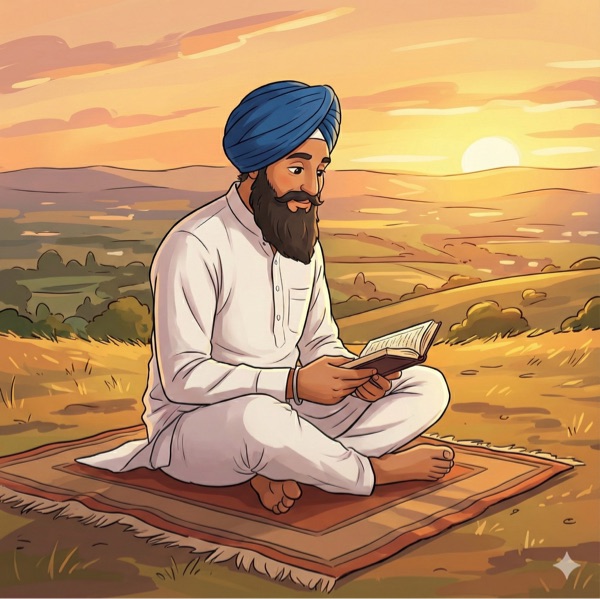
On 27 March 1628 CE, Mata Ganga Ji—the revered mother of Sri Guru Hargobind Sahib Ji—left her five-element mortal body and went to rest at the sacred feet of Sri Guru Arjan Dev Ji Maharaj. Mata Ganga Ji It is recorded by several historians that Sri Guru Arjan Dev Ji had an earlier marriage during the time of Sri Guru Ram Das Ji. Gyani Sohan Singh Seetal writes that “Sri Guru Arjan Dev Ji’s first marriage was to Bibi Ramo Devi, the daughter of Bhai Chandan Das Khatri of village Maur. She passed away after a short time without bearing any children. The second marriage of the Fifth Guru was to Bibi Ganga Ji, the daughter of Bhai Kishan Chand Khatri of village Mao in the Phillaur region. She became widely known in Sikh history as Mata Ganga Ji and is held in high honor.” Mata Ganga Ji was born around 1567 CE in village Mao (also written as Maua/Mo‘a), about eight miles southwest of Phillaur, to Bhai Kishan Chand Khatri and Mata Dhanvanti. A traditional oral account about the Guru’s wedding—heard by the writer at a Gurdwara built in memory of the wedding in Mao—narrates the following: When Sri Guru Arjan Dev Ji came for the wedding, he was accompanied by renowned Sikhs skilled in horse riding and equestrian games. Guru Ji himself was an excellent rider. The day after the baraat arrived, before the wedding rounds, villagers told Guru Ji of a local custom: every groom must demonstrate spear-sport (neza-baazi). Guru Ji accepted. Some young men wished to test Guru Ji’s strength and skill. They cleverly cut a tree in such a way that its roots remained, shaping it to look like a fort-like post. The entire village gathered outside to watch. Guru Ji galloped from a distance, struck the “fort” with the spear, and uprooted it along with its roots. People were astonished. However, due to the tremendous exertion, Guru Ji’s beloved horse collapsed and died. Guru Ji remarked that just as the roots of that “fort” were pulled out, so too would the roots of village Mao be uprooted. Later, the village was indeed devastated by raiders and many survivors relocated. The site can still be seen. The wedding date is traditionally given as 23 Harh (1588), and a large fair is held there on 21, 22, and 23 Harh. Mata Ganga Ji was greatly blessed to have Mata Bhani Ji (a saintly embodiment of seva and simran) as her mother-in-law, and Sri Guru Arjan Dev Ji—known for patience, compassion, and sweet speech—as her husband. From the time she entered the Guru’s household, she served Mata Bhani Ji with devotion and care. She took active interest in Guru Ji’s responsibilities and supported him fully, as recorded in historical accounts. For example, when Guru Ji undertook the monumental work of compiling Gurbani and Bhagat Bani for the Aad Granth, he spent extended periods away. Mata Ji skillfully managed matters in his absence and rejoiced deeply upon the success of that sacred mission. Bhai Santokh Singh mentions her joy and devotion. Mata Ganga Ji found deep spiritual happiness through seva. Patience, contentment, restraint, and sacrifice became her ornaments. Many verses in historical writings portray her love and dedication. The Blessing of Baba Budha Ji After many years without a child, Mata Ganga Ji became concerned, especially after hearing jealous remarks from Karmo (wife of Prithi Chand). When expensive garments from the Guru’s household were aired out, Karmo’s envy grew and she provoked Prithi Chand, who arrogantly claimed that Mata Ganga Ji would never bear a child and that the Guruship would come to his son Mehrban. Mata Ganga Ji informed Guru Ji and requested the blessing of a son. Guru Ji said that Baba Budha Ji—an exalted saintly figure who had served and met the first five Gurus—could fulfill her wish, and advised her to prepare pure langar and serve him. Mata Ji initially went with grand arrangements, but Baba Budha Ji’s words felt like a sharp rebuke rather than a blessing, and she returned disappointed. Guru Ji then explained that true spiritual blessings are sought through humility, not display. So Mata Ganga Ji rose before dawn, recited prayers, churned milk into butter, prepared simple rotis, filled a pot of lassi, and walked alone—barefoot and in a humble, simple manner—to Baba Budha Ji’s forest (Bir). This time, Baba Budha Ji came forward to receive her, accepted the offerings, and blessed her with powerful prophetic words—that a mighty warrior would be born to her, who would crush the heads of tyrants just as Baba Budha Ji crushed a sugarcane (ganda) in his fist. The blessing came true. On 9 June 1595, Sri Guru Hargobind Sahib Ji was born at Bhai Hema’s haveli in village Wadali. Sikh devotees celebrated with great joy. Mata Bhani Ji rejoiced at seeing a moon-like grandson. Mata Ganga Ji was overwhelmed with happiness and love for the child. Conspiracies Against the Child and Divine Protection As enemies of the Guru increased, Guru Arjan Dev Ji had to leave Amritsar and come to Wadali. Mata Ganga Ji remained safe. Later accounts narrate multiple attempts by Prithi Chand’s side to harm the child through poison and other means—bribing a nurse, sending poisoned curd through a Brahmin, releasing a venomous snake through a snake-charmer, and arranging poisoned sweets through a child companion—yet each attempt failed, and the child remained protected. When the child suffered from smallpox, Mata Ganga Ji became anxious, but Guru Ji reminded her that the child was a Divine gift and would be protected by the One who bestowed him. The child recovered, and Guru Ji recited shabads in gratitude (Ang 627). Education and Guidance After Guru Arjan Dev Ji’s Martyrdom During the time Guru Arjan Dev Ji was engaged in the sacred establishment of the Aad Granth, Mata Ganga Ji played a significant role in her son’s upbringing and education. With guidance through Baba Budha Ji and others, the child was trained in literacy and Gurmat, in shastar-vidya (weapons training), and in horse riding. At the time of Guru Arjan Dev Ji’s martyrdom, Guru Hargobind Sahib Ji was only eleven years old. Mata Ganga Ji was deeply affected. Yet, following Guru Ji’s teachings that all who are born must depart and that one must accept Divine Will, she attached herself to Gurbani and encouraged the Sangat to do the same. She provided powerful support and direction to the young Guru, and Guru Hargobind Sahib Ji honored his mother like his father—seeking her blessings and guidance at every major moment, including after the establishment of the Akal Takht. Passing of Mata Ganga Ji A devoted Sikh, Bhai Mihra Ji of Bakala, built a haveli and vowed not to live in it until Guru Hargobind Sahib Ji blessed it with His presence. One day, Guru Ji arrived in Bakala with the family, and Sangat camps formed outside. Mata Nanaki Ji took Mata Ganga Ji to her parental home as permitted. During this spiritually vibrant stay—filled with Asa di Vaar in the morning, dhadhi-vars by day, and Guru’s teachings by night—Mata Ganga Ji sensed her final moment approaching. After bathing and wearing clean clothes, she called Guru Ji and requested that her body be immersed in the Beas River so she could “reach her husband” spiritually. Mata Ganga Ji departed on Chet Sudi 14 in 1628 (some historians cite 1626). Guru Ji recited Japji Sahib and Sukhmani Sahib, and Mata Ji is described as leaving in a state of deep spiritual absorption. A ceremonial bier was prepared, the Sangat offered final darshan, and a Gurdwara was later built at the place where the bier was kept—known as “Mata Ganga Da Dera,” where a major night-long kirtan program is held annually. A girls’ school named after Mata Ganga Ji also operates in Bakala. Her body was taken in procession and immersed in the Beas River after prayer. Mata Ganga Ji endured repeated deadly conspiracies against her only son, bore the profound pain of her husband’s martyrdom, and still provided complete protection and guidance to young Guru Hargobind Sahib Ji. Her support is remembered as significant in the revolutionary turn of “Miri-Piri” and the creation of the Akal Takht. She also helped clear doubts in the minds of the Sangat and masands and remained a pillar of love and faith for the Guru’s household. She holds the rare honor of being Guru’s wife, Guru’s mother, Guru’s grandmother, great-grandmother, and even further ancestral matriarch in the lineage. Servant, Zorawar Singh Tarsikka.
Please log in to comment.