
Janamdin Sahibzada Jujhar Singh ji
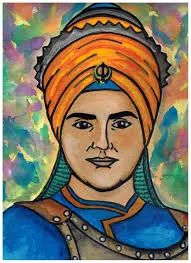
Baba Jujhar Singh Ji was born on 27 Chet 1691. Heartiest congratulations to the entire Sangat.
Sahibzada Jujhar Singh Ji was the son of the Tenth Guru, Sri Guru Gobind Singh Ji, the grandson of the Ninth Guru, Sri Guru Tegh Bahadur Sahib Ji, and the great-grandson of the Sixth Guru, Sri Guru Hargobind Sahib Ji. He was born on April 9, 1691, at Sri Anandpur Sahib to Mata Jeet Kaur Ji.
Sahibzada Jujhar Singh Ji was very intelligent, and at a young age he had already memorized a large amount of Gurbani. Along with this, he also learned horsemanship and the art of weaponry. He loved all his brothers and the Gursikhs deeply. He was very learned and fond of Naam. He spent much of his time at Anandpur Sahib.
On the night of December 20, when Sri Guru Gobind Singh Ji decided to leave Sri Anandpur Sahib, Sahibzada Jujhar Singh Ji was with him. After crossing the Sarsa River, Guru Sahib was accompanied by 40 Sikhs and the two elder Sahibzadas, Ajit Singh Ji and Jujhar Singh Ji. On the opposite bank, Bhai Uday Singh Ji kept repelling repeated Mughal attacks. He fought bravely until not a single soldier remained alive with him, and in the end, while obeying the Guru’s command and fulfilling his duty, he attained martyrdom on the battlefield.
In this turmoil, Guru Sahib’s family became separated from him. In the jatha of Bhai Mani Singh Ji were Mata Sahib Kaur Ji, Mata Sundari Ji, and two attendant women. Two Sikh brothers, Jawahar Singh and Dhanna Singh, who were residents of Delhi, managed to cross the Sarsa River. They all traveled via Haridwar and reached Delhi, where Bhai Jawahar Singh took them to his home.
In the second group were Mata Gujri Ji and the younger Sahibzadas, Zorawar Singh Ji and Fateh Singh Ji, who went along with Gangu Ram, a Brahmin cook of Guru Ghar. His village, Khehri, was about 15 kos away near the town of Morinda. Gangu Ram took Mata Gujri Ji and the younger Sahibzadas to his village.
Guru Sahib moved ahead with his forty Sikhs and by noon reached a garden outside the area of Chamkaur. The local people warmly welcomed Guru Sahib and offered every possible help. There stood a mud fortress-like haveli, strategically important because it was built on a raised mound with an open plain all around it. The owner of the haveli, Budhi Chand, requested Guru Sahib to rest there.
Guru Sahib did not think it proper to move further. He divided the forty Sikhs into small groups, distributed the remaining weapons among them, and stationed them at defensive positions. Everyone now knew that death was certain, but the Khalsa principle was never to surrender arms before the enemy, only to attain martyrdom. Thus, all the Sikhs prepared themselves to sacrifice their lives.
Guru Sahib began planning how to fight the countless Mughal forces with the strength of only forty Sikhs. He himself took position in the upper part of the mud fortress. The other Sikhs also occupied their respective positions and waited for the Mughal army.
Meanwhile, as soon as the flow of the seasonal Sarsa stream reduced, the Mughal army crossed it like a swarm of locusts and chased Guru Sahib into the plains of Chamkaur. In no time, they surrounded the mud fortress. The Mughal commanders had learned from the villagers that Guru Sahib had only forty soldiers with him, and they began dreaming of capturing him.
At daybreak, Wazir Khan, the Nawab of Sirhind, had it proclaimed that if Guru Sahib surrendered himself along with his companions to the Mughal authorities, their lives would be spared. In response to this proclamation, Guru Sahib unleashed a shower of arrows upon the Mughal forces.
At that time, the battle was between forty Sikhs and a Mughal force numbering in the thousands and beyond. Guru Sahib had already vowed that each Sikh would fight against one and a quarter lakh. Now the blessed opportunity had come to demonstrate this vow before the world. On December 22, 1705, one of the most unique battles in history began. Dark clouds filled the sky and a light drizzle was falling. Because it was the shortest day of the year, the sun rose late. A biting cold wind blew, yet the hearts of Guru Sahib’s Singhs, sheltered in the mud fortress, were burning with courage.
When Sahibzada Jujhar Singh Ji saw his elder brother Sahibzada Ajit Singh Ji attain martyrdom in battle, he too sought Guru Sahib’s permission to enter the battlefield. Guru Sahib patted his back and sent his young son into battle along with four other Singhs.
Guru Sahib watched Jujhar Singh Ji fighting in the battlefield with joy and, seeing his skill in combat, raised loud cries of victory:
“Jo Bole So Nihal, Sat Sri Akaal!”
Jujhar Singh Ji became surrounded by the enemy army, but even then he displayed extraordinary bravery and attained martyrdom. He was only 14 years old.
Because of the rain and clouds, evening came quickly. It was the shortest day of the year, the cold was severe, and as darkness fell, the battle came to a halt. Seeing both Sahibzadas attain martyrdom, Guru Sahib offered a prayer of gratitude before Akal Purakh and said:
Nothing is mine within myself; whatever there is, is Yours.
As I return to You what already belongs to You, what loss is mine?
Join the conversation
Sign in to comment or join the discussion.

Loading comments…