Chhota Ghallughara Kahnuwan (Gurdaspur)
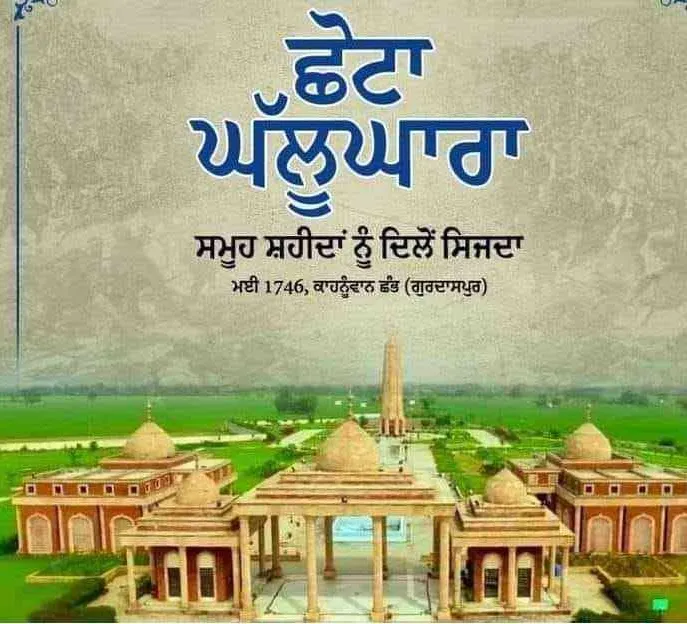
After the death of Subedar Zakariya Khan, Yahya Khan became the governor of Lahore. Lakhpat Rai was his Diwan. Diwan Lakhpat Rai and his brother Jaspat Rai had resolved to wipe out the Sikhs completely.
In one clash, Jaspat Rai was killed by the Sikhs. To avenge his death, Diwan Lakhpat Rai decided on 10 March 1746 to massacre the Sikhs living in Lahore.
Kaura Mall, along with respected citizens of the city, tried to stop Lakhpat Rai from committing such atrocities, but ignoring everyone, he had thousands of Sikhs killed. Afterwards, on 16 May 1746, he gathered an army and set out in search of the Sikhs hiding in the forests. In the marshlands of Kahnuwan, around seven thousand Sikhs were killed in battle. Nearly three thousand Sikhs were captured and executed. This incident is remembered in Sikh history as the “Chhota Ghallughara” (the Lesser Holocaust).
The word “Ghallughara” originates from the Afghan language and literally means total destruction, large-scale massacre, genocide, or devastation. The Sikh nation has always fought against oppression and has never accepted slavery or submission, which is why Sikhs had to endure terrible massacres at different times in history.
Disheartened by this shameful act of Lakhpat Rai, Kaura Mall left for Multan.
When Nawab Kapur Singh learned of these brutalities, he sent messages to leading Sikh chiefs and various Sikh groups, asking them to gather at the Kahnuwan marshes in Gurdaspur district, located about 8 kilometers from the road leading to Mukerian and 4 kilometers to the right of the military camp.
Sardar Jassa Singh Ahluwalia also joined this gathering. In the coming years, he served the Sikh nation as a great general. References to this event are found in “Panth Prakash” written by Rattan Singh Bhangu. Around 15,000 Sikhs assembled in the marshlands, though some historians estimate the number at 25,000.
Upon receiving intelligence about this gathering, Yahya Khan, the son of Zakariya Khan, along with Lakhpat Rai, arrived with a heavily armed army equipped with artillery and ammunition. Cannons fired blazing shells upon the Sikhs. At night, the Sikhs took advantage of the darkness, seized the enemy’s food supplies, and returned to the marshes to prepare for the next day’s battle. Hungry and exhausted, the Sikhs continued fighting in this manner for a long time.
When Kaura Mall, the governor of Multan, came to know about their condition, he secretly loaded provisions onto horses and mules under the pretext of sending them to Jammu and Kashmir. Through secret messengers, he informed the Sikhs to seize the supplies as they passed by. The Sikhs did exactly that. Because of this sympathy and assistance, history remembers Kaura Mall as “Mitha Mall” (the Sweet Mall).
The battle continued for a very long period, more than a month. Eventually, the Sikhs’ food supplies ran out, ammunition was exhausted, and their weapons became blunt from constant fighting.
Lakhpat Rai’s uncle and son were also killed by the Sikhs. Seeing defeat approaching, Lakhpat Rai resorted to cruel tactics. Thinking about how he would face the Delhi court after such failure, he gathered blacksmiths and carpenters from nearby villages and ordered the surrounding forest to be cut down and set on fire from all sides.
The Sikhs were trapped from every direction — the unbearable summer heat, the raging forest fires, hostile hill chiefs positioned on higher ground, and the roaring Beas River on the other side.
To preserve the honor of the Sikh faith, the Sikh generals resolved to fight bravely in the battlefield and embrace martyrdom. With cries of “Chardi Kala,” the Sikhs charged against the enemy. Many Sikhs attained martyrdom while fighting the Mughal forces. Among them was Sukha Singh, leader of one of the groups, who inflicted severe damage upon the Mughal army before being wounded himself.
In the struggle, many Sikhs jumped into the river. Some drowned, some escaped towards the hills, and others moved towards Kiratpur Sahib. Many were captured by the Mughals.
Yahya Khan’s younger brother was Shah Nawaz Khan. A struggle for power continued between the two brothers.
On 11 January 1748, Ahmad Shah Durrani captured Lahore, but soon after, he was defeated near Sirhind and returned to his homeland.
At that time, the Mughal government in Delhi decided to appoint Mir Mannu as the governor of Lahore. Mir Mannu was the son of the Mughal Wazir Qamar-ud-Din. On 11 April 1748, Mir Mannu was appointed governor of Punjab, and Lakhpat Rai became his Diwan.
However, Lakhpat Rai himself desired to become the governor of Lahore. He secretly began forming alliances with Ahmad Shah Abdali. When Mir Mannu learned of this conspiracy, he removed Lakhpat Rai and appointed Kaura Mall as his Diwan instead.
Join the conversation
Sign in to comment or join the discussion.
Chhota Ghallughara Kahnuwan (Gurdaspur) – Part 2
Diwan Kaura Mall was a well-wisher of the Sikhs and also had deep devotion for the Guru’s house. Even earlier, he had secretly helped the Sikhs…
Continue in the Nitnama app
Loading comments…