Birthday of Sardar Jassa Singh Ahluwalia
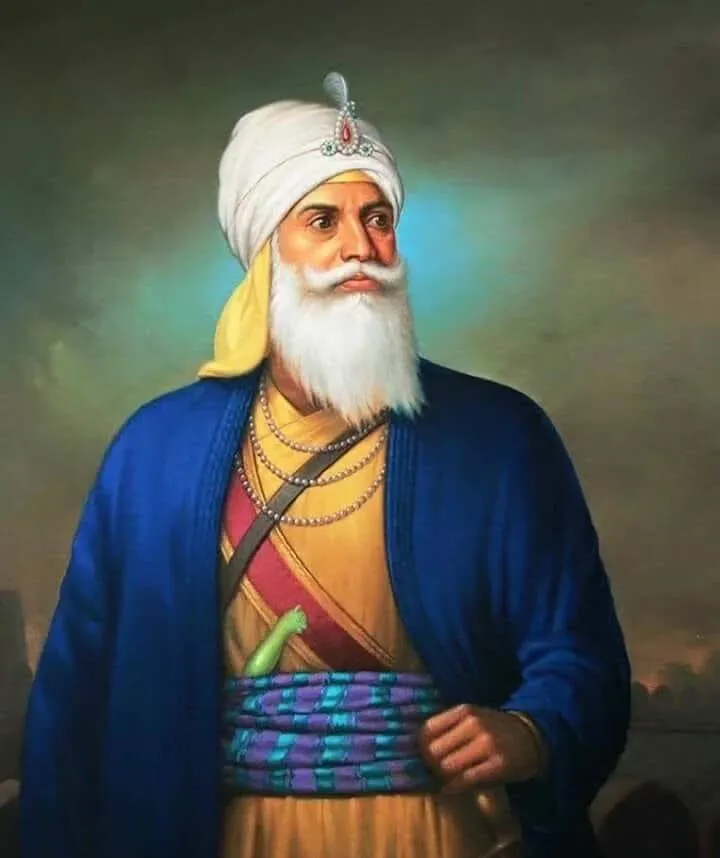
Sardar Jassa Singh Ahluwalia was born on 5th Jeth, 1718 CE, to Sardar Badar Singh and Mata Jeevan Kaur in the village of Ahlu, District Lahore (now in Pakistan). When he was only five years old, his father passed away.
His mother, with the help of her brother Sardar Bhag Singh, sent him to Delhi to stay with Mata Sundari Ji, the wife of Sri Guru Gobind Singh Ji. Living under the care of Mata Sundari Ji, he devoted himself to service and meditation. Mata Sundari Ji was deeply pleased with his noble character and treated him like her own son. During his stay, he gained knowledge of several languages and also mastered the art of weaponry under her guidance. When he was leaving Delhi, Mata Sundari Ji honored him with a shield, kirpan, mace, bow and arrows, and a silver staff, recognizing his dedication to Sikh principles and righteous living.
After arriving in Punjab, he joined the jatha of Nawab Kapur Singh. Due to his noble nature and sharp intellect, he quickly earned a special place in Nawab Kapur Singh’s heart. In 1748 CE, Nawab Kapur Singh and Jassa Singh Ahluwalia defeated the Mughal commander Salabat Khan. On the occasion of Vaisakhi at Sri Akal Takht Sahib, 65 jathas were organized into 11 misls (later 12 with the Phulkian Misal), and the Dal Khalsa was formally established.
The major misls and their leaders were: Singhpuria or Faizalpuria Misal led by Nawab Kapur Singh, Ahluwalia Misal led by Sardar Jassa Singh Ahluwalia, Bhangi Misal led by Hari Singh Bhangi, Sukerchakia Misal led by Charat Singh, Nishanwalia Misal led by Dasaundha Singh, Ramgarhia Misal led by Jassa Singh Ramgarhia, Shaheed Misal led by Baba Deep Singh Ji, Kanhaiya Misal led by Jai Singh Kanhaiya, Dallewalia Misal led by Tara Singh, Nakai Misal led by Hira Singh Lahore, and Karorasinghia Misal led by Karora Singh of Panjgarh, Gurdaspur. In addition, the rulers of Patiala, Nabha, Jind, Phulkian, and Faridkot formed the Phulkian Misal.
These misls divided and established control over large regions of Punjab. During this period, Ahmad Shah Abdali invaded from Lahore to Delhi, carrying out massive looting and atrocities. He forcibly married Emperor Alamgir’s beautiful young daughter, Juhra Begum, to his son Timur Shah. After Delhi, he looted Agra and later attacked Mathura and Vrindavan during the Holi festival, plundering temples and stealing gold and silver idols. Many innocent women and girls were dishonored.
After the plunder, Abdali returned to Delhi and later left for Kabul in April 1757 with enormous wealth, royal princesses, nearly 20,000 Hindu women and girls, and countless captives. When Sardar Jassa Singh Ahluwalia received this news, he called upon the Khalsa, declaring that if Abdali succeeded in taking away the wealth and daughters of India through Punjab, how could they face Guru Gobind Singh Ji? Upon receiving the message, the Khalsa immediately prepared for battle.
“The true Khalsa is one who mounts the steed,
The true Khalsa is one who fights daily in battle.”
Ahmad Shah Abdali launched ten invasions of India between 1747 and 1769. Along with Baba Deep Singh Ji, Sardar Jassa Singh Ahluwalia attacked Abdali’s forces, recovered the looted wealth, rescued the captive women, and inflicted heavy losses upon the Afghan army. Abdali barely escaped with his life. For these heroic deeds, Jassa Singh Ahluwalia was honored with the titles “Sultan-ul-Qaum” and “Bandi Chhor.”
In 1762, Abdali invaded India again. During this invasion, nearly 20,000 Sikh men, women, children, and elderly people were massacred in what came to be known in Sikh history as the “Vadda Ghallughara” (The Great Holocaust). In this battle, Sardar Jassa Singh Ahluwalia suffered 22 wounds on his body. While retreating, Abdali blew up Sachkhand Sri Harmandir Sahib with gunpowder and filled the holy sarovar with debris and soil.
Afterward, Jassa Singh Ahluwalia reorganized the Dal Khalsa and, in 1764, attacked Sirhind, killing its governor Zain Khan. In 1765, Abdali launched another invasion, but seeing the growing power of the Sikhs, he attempted to negotiate peace. However, Jassa Singh Ahluwalia firmly rejected the proposal.
In 1774 CE, Sardar Jassa Singh Ahluwalia made Kapurthala his capital. He was a great military leader and a deeply spiritual man who dedicated his entire life to the service of the Guru and the honor of Sikhism. On 20 October 1783, this great warrior passed away. His memorial is located near Baba Atal Rai Ji’s shrine in Amritsar. Millions salute this legendary hero with deep respect.
Join the conversation
Sign in to comment or join the discussion.
Loading comments…