

Death Anniversary of Baba Jawand Singh Ji
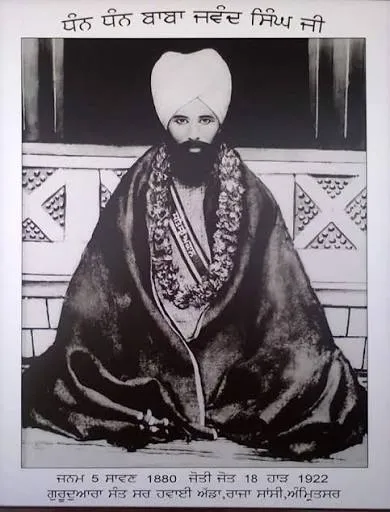
Baba Jawand Singh Ji, a lover of Naam and a possessor of spiritual strength, was born on 5 Sawan, 1880, in village Bhangwan, near Jandiala Guru, district Amritsar Sahib, from the blessed womb of Mata Khemi Ji and in the home of father Sardar Nattha Singh Ji. His brother Sher Singh Ji was 5 years older than him.
In childhood, Baba Ji remained absorbed in devotion to God, and whatever words he uttered from his tongue would come true. His Anand Karaj took place at the age of 17 with Ishar Kaur Ji, daughter of Sardar Ganda Singh Ji, a resident of village Marar. A son was born in his house, who was named Sant Singh Ji. Sant Singh Ji’s Anand Karaj took place in village Talwandi, Batala, and his son was named Sukhdev Singh.
Baba Jawand Singh Ji’s father-in-law got him recruited into the Delhi Police. During his service, Baba Ji used to perform kirtan of Asa Di Vaar at Gurdwara Sis Ganj Sahib. Sangats from far and wide would come to listen to Baba Ji’s kirtan.
Because of his deep pull toward the feet of the Divine, Baba Ji left his job and went with contractor Sardar Boota Singh to Gurdwara Rawalpindi. After some time, Baba Ji came to Ferozepur. He met Baba Nand Singh Ji of Nanaksar. Both great souls used to do bhagti together.
It was here that, after deep meditation, Baba Ji had the direct vision of Sri Guru Nanak Dev Ji through Sri Guru Granth Sahib Ji. Later, Baba Ji went to Rajasansi and performed bhagti there. Today, Gurdwara Santsar stands at that place, named after Baba Ji’s son Sant Singh Ji, and it is located at Rajasansi Airport.
The foundation stone of the first building of this Gurdwara Sahib in village Bhangwan was laid by Baba Ji with his own blessed hands. Baba Ji also went to Baramulla, Kashmir, to guide the sangats toward Naam Simran. He often used to visit Hoti Mardan, and Baba Aya Singh Ji would listen to his kirtan with great attention.
On 18 Harh, 1922, Baba Ji left for Sachkhand, giving the sangats the message to meditate on Naam, earn an honest living, and keep complete faith in Dhan Dhan Sri Guru Granth Sahib Ji.
Bhai Jawand Singh Ji
As the nineteenth century was nearing its end, this kirtaniya, born in a village called Bhangwan near Jandiala, was performing kirtan in a gurdwara in Delhi. A famous contractor from Rawalpindi, Boota Singh, who had taken the contract for the Ferozepur Fort in those days, heard him. Being impressed by his kirtan, he made a firm arrangement to give him a job at twelve rupees per month and brought him to Ferozepur, where his father-in-law was working as a watchman.
The kirtaniya was appointed as a munshi over the men working in the fort and began living there with his in-laws. Although he originally belonged to the Amritsar district, he came to be known as “the one from Ferozepur” because he spent most of his life there.
He had asked Sant Karam Singh Ji of Hoti Mardan for only one blessing: that he should never be touched by attachment to worldly wealth. This was why he never had a pocket stitched onto his chola and always remained detached from maya.
Even when his wife passed away, an official of the ruler of Faridkot told the Maharaja that some stipend or jagir should be given to his son Santa Singh. Baba Ji’s reply was, “No, brother, no, absolutely not. Just as I grew up through hardships, he too will grow up in the same way.”
Whether it rained or there was a storm, Baba Ji would bathe twice a day, even if he had a fever as high as 104. Apart from kirtan, he remained absorbed in Nitnem and Simran. Because of his deep spiritual discipline, people began calling him a saint, but he did not feel pleased when addressed in this way.
Apart from the Bani of the Guru Sahiban, Baba Ji sang the Bani of Baba Farid Ji more often. Because of this, some people, out of devotion, began calling him a second Farid. His dharnas were sweet and simple, and the sangat would happily sing along with him.
Ratan Singh used to play the dholki with him, Harnam Singh played the harmonium, and behind the jatha sat others such as Bhai Lal Singh, Jathedar Thakur Singh, and Bhagat Singh.
“Hoey varkha amrit di, Satguru de darbar” and “Mann moh leya Guru Nanak ne, amrit shabad sunaya” — whenever Baba Ji sang such simple and soulful dharnas with deep devotion, it felt as if Guru Nanak Dev Ji was appearing before the sangat.
Chaudhary Attar Singh, the builder of Kanya Maha Vidyalaya, Bawa Pala Singh Jathedar, Thakur Singh, Babu Sundar Singh of the cantonment, Hakim Chuhar Bhan, Dr. Amrik Singh, Dr. Balwant Singh, Bhana Mall Advocate, and many other respected people of the city were his special admirers.
When Baba Ji sang Asa Di Vaar, it felt as if a shower of nectar had begun. The spiritual radiance of his stage was something unique. Once, Baba Ji even traveled to China to raise funds for the construction of Kanya Maha Vidyalaya in Ferozepur, the oldest girls’ institution in Punjab.
Before the partition of the country, Ferozepur’s Heera Mandi was also famous for courtesans, where even great singers like Bade Ghulam Ali Khan from Kasur would come to listen to their singing. It is important to clarify here that in those times, this was not mainly associated with immoral acts or lust. Rather, for the wealthy and lovers of music, listening to mujra was considered a part of the cultural mushaira-like gatherings of that period.
There is a famous incident that two well-known courtesans from that place, one of whom was named Rajo, heard Baba Jawand Singh Ji singing. They were so deeply impressed that they asked, “We want to listen to him. What is the fee?”
The reply came, “Only ten rupees — five for Karah Prasad, two and a half for flower garlands, and two and a half for lassi and water for the jatha.”
This time, Rajo was so deeply moved that after the program she fell at his feet and asked him for the blessing of Sikhi. But Baba Ji replied that first she should enter married life. As a result, after a few days, she was blessed with Amrit. Her name was changed to Hukam Kaur, and she was married to a man named Sewa Singh Kamboj.
For a Muslim courtesan sitting in the Heera Mandi of that era to be so deeply moved by the singing of a Sikh kirtaniya was a remarkable example of that time. Otherwise, Muslim ustads and courtesans rarely acknowledged the excellence of Sikh musicians.
Baba Ji also composed simple poetry and used the pen name “Jeevan Mukt.” Baba Ji passed away at Rajasansi, Amritsar, Guru Ram Das Airport, in 1922 at the age of 42.
Zorawar Singh Tarsikka
7277553000
Join the conversation
Sign in to comment or join the discussion.




Loading comments…