The Passing of Sain Mian Mir Ji
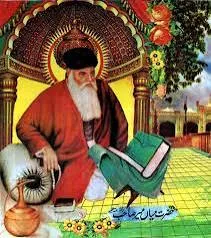
Sain Ji was born into the family of Qazi Sain Ditta in Sistan in 1550 CE, although some historians have recorded his year of birth as 1535. His full name was Mir Muin-ul-Islam. His ancestry is believed to have traced back to Hazrat Umar. Sain Ji had two sisters and three brothers.
From childhood, he had a deep inclination towards prayer and devotion. He received his education from Khwaja Khizr, Maulana Sayyid Allah, and Maulana Niamat Allah Ji.
After completing his studies, he would go alone into a garden or forest and become absorbed in the remembrance of God. From an early age, he followed the principle of eating simple food and only as much as was necessary.
Whenever someone came to meet him, he would say:
“You have your work, and I have mine.
Why, then, should we waste time?”
Whenever he did speak, he spoke only about Allah.
He wore a dastar on his head and a khaddar kurta. He washed his own clothes and was extremely particular about cleanliness. He never wore dirty clothes.
He lived so simply that only rough sacks were spread on the floor of his room for people to sit upon.
Whether rich or poor, everyone sat on those same sacks when visiting him. Emperor Jahangir, Shah Jahan, royal princes, Begum Nur Jahan, and Dara Shikoh were among those who came to meet him and sat there like everyone else.
Jahangir was so addicted to alcohol that even Nur Jahan had been unable to make him give it up. Sain Ji spoke to him only once, and Jahangir reduced his drinking so greatly that he himself was astonished. Such was the blessing and influence contained in Sain Ji’s words.
He never accepted expensive gifts. On one occasion, Shah Jahan presented him with a rosary made from date stones, but Sain Ji gave it away to someone else.
Although he was a Muslim, he had a great love for listening to kirtan. He possessed deep devotion and respect for the house of the Guru.
He had great affection for Guru Arjan Dev Ji Maharaj even before Guru Sahib ascended the Guruship. Guru Sahib also respected him so deeply that he invited him to lay the foundation stone of Sri Harmandir Sahib.
A poet wrote:
The foundation stone of Harmandir bears witness
that there was once a time when friendship smiled among people of different faiths.
Sain Ji greatly loved the sacred Bani of Sukhmani Sahib and had memorised it in its entirety.
He also made efforts to prevent the martyrdom of the Fifth Guru, Guru Arjan Dev Ji. Guru Sahib, however, asked him to accept the Divine Will as sweet.
Sain Ji became deeply sorrowful after Guru Sahib’s martyrdom.
He also shared a profound bond of love with the Sixth Guru, Guru Hargobind Sahib Ji. When Satguru Ji was arrested, Sain Ji was so distressed that he personally travelled from Lahore to Agra.
He described Guru Sahib’s spiritual greatness to Jahangir and said:
“He is the Light of God. When I enter the Divine Court, it is his vision that I behold there as well.”
Nur Jahan told him that Jahangir was frequently ill and requested him to bestow some mercy upon the emperor.
Sain Ji replied:
“How can mercy be received after imprisoning God?”
Sain Ji returned to Lahore only after Satguru Ji had been released.
On one occasion, Jahangir said to him, “Ask for something. I wish to give you whatever you desire.”
Sain Ji replied:
“From this day onward, do not summon me to your court.”
After that day, he never again went to the emperor’s court. Jahangir, however, continued to visit him occasionally.
During the final days of his life, Sain Ji remained ill for five days. Wazir Khan, who was himself a physician, made many efforts to treat him.
Sain Ji, however, said:
“Only the Great Physician can cure me now.”
On 11 August 1635, he departed from this world. His body was buried at Hashimpura, near Lahore.
Nur Jahan had a beautiful mausoleum constructed in his honour. Later, Dara Shikoh ordered red stone to be brought for the mausoleum. However, Aurangzeb subsequently had the stone removed and used for another royal mosque.
During the rule of the Khalsa Sarkar, when Sher-e-Punjab Maharaja Ranjit Singh learned about the neglected and deteriorating condition of Sain Ji’s mausoleum, he personally visited the site.
He immediately assigned Fakir Nur-ud-Din the responsibility of restoring it and ordered:
“The mausoleum must be rebuilt magnificently. Whatever the cost may be, take it from the state treasury.”
The life of Sain Mian Mir Ji as a dervish reflected the spirit of these sacred words of Baba Farid Ji:
Those whose hearts contain true love are the truthful ones.
Those who hold one thing in their minds but speak another are considered false. ॥1॥
Those who are immersed in the love of God and in the longing for His vision are truly blessed.
Those who have forgotten the Divine Name have become a burden upon the earth. ॥1॥ Pause॥
Those whom God Himself has drawn close to His robe are the dervishes of His Court.
Blessed are the mothers who gave birth to them; their coming into the world was fruitful. ॥2॥
O Sustainer, You are infinite, inaccessible, and without end.
I bow down and kiss the feet of those who have recognised the Truth. ॥3॥
O God, I seek Your protection; You are the One who forgives.
Bless Sheikh Farid with the gift of devotion. ॥4॥
Repeated salutations and prostrations before such a great dervish.
Join the conversation
Sign in to comment or join the discussion.
Loading comments…