

Bhagat Puran Singh Ji
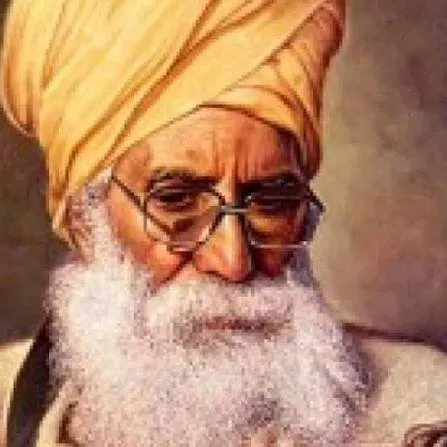
On 5 August, Bhagat Puran Singh Ji of Pingalwara left his mortal body and went to rest at the feet of Guru Nanak Sahib Ji. Let us take a brief look at his remarkable life.
On 4 June 1904, a saintly soul was born in the village of Rajewal in Punjab. His parents named him Ram Ji Das. Today, the entire world knows that noble soul as Bhagat Puran Singh Ji.
Bhagat Puran Singh Ji’s father, Chhibbu Mal, was a prosperous Khatri businessman who was also engaged in moneylending. His business was destroyed during the famine of 1913, plunging the family into severe financial hardship.
His mother, Mata Mehtab Kaur Ji, dreamed of providing her son with a good education. However, the family’s poverty filled her with worry.
A determined and strong-willed woman, Mata Mehtab Kaur agreed to wash utensils in other people’s homes to arrange money for her son’s school fees.
Bhagat Puran Singh Ji received his early education at the village government school and at the Anglo-Sanskrit School in Khanna. He later moved to Lahore.
Although he was not greatly interested in formal school education and could not fulfil his mother’s dream of passing the tenth standard, he possessed an intense thirst for knowledge.
Through self-study, he gained immense knowledge from the libraries of Lahore and Amritsar.
Along with studying independently, he began performing seva at Gurdwara Dera Sahib in Lahore. He served drinking water, helped in the langar, cleaned the premises and washed utensils.
Even while walking along the roads, he would remove bricks, stones, pieces of glass, thorns and thorny bushes from the path so that travellers would not be injured or inconvenienced.
Through a life devoted to seva, Ram Ji Das, who had been born into a Hindu family, became deeply influenced by the Sikh faith and adopted the Sikh form.
One day, he met the Granthi, Jathedar Achhar Singh Ji, at the Gurdwara Sahib and explained the purpose of his life.
He said that he wished to serve abandoned, mentally ill and physically disabled people—those whom society ignored and for whom no one cared.
The Gurdwara management arranged for his food and accommodation within the Gurdwara premises.
Bhagat Puran Singh Ji devoted most of his life selflessly to caring for the elderly, the sick, people with disabilities and those without support.
In 1934, while he was performing seva at Gurdwara Dera Sahib in Lahore, he found a four-year-old disabled child abandoned outside the Gurdwara gate.
He accepted complete responsibility for the child and named him Piara Singh.
Piara Singh was the first foundation of Bhagat Puran Singh Ji’s lifelong mission of service.
He loved the child as though he were his own son and often said:
“This child is the greatest support of my life. Had he not come into my life, perhaps I would never have been able to accomplish anything.”
For nearly fourteen years, Bhagat Ji carried the child on his back and looked after him.
The unequal social conditions that existed before the Partition of India, together with the terrible destruction of human life during Partition, left a deep impression on Bhagat Puran Singh Ji.
While caring for sick, injured and abandoned people living in refugee camps, he performed a role similar to that of Bhai Ghanaiya Ji.
Throughout his journey from Lahore to Amritsar, he supported the homeless, the helpless and those without shelter in every possible way.
At different times, he became like a mother, a father or an elder brother to those in need. He remained constantly available for the service of humanity.
Writing about the Partition of 1947, Bhagat Ji stated:
“I came from Pakistan carrying one rupee and five annas. I was wearing a kachhera, and a phulkari was draped over me. Apart from this, I had an iron bowl, two large notebooks, two English magazines and a disabled child on my back.”
For some time, he stayed at a refugee camp established at Khalsa College.
After the college camp was closed, he lived for a while at the railway station and spent some time beneath the shelter of trees.
Gradually, the number of people in his growing family—the abandoned and disabled people under his care—continued to increase. A permanent place was urgently needed where they could be sheltered and cared for properly.
At the time, they were staying in an abandoned cinema building. As circumstances unfolded, the price of the cinema property reached 35,000 rupees.
Bhagat Ji had no savings of his own.
At that time, a meeting of the Shiromani Gurdwara Parbandhak Committee was taking place. He explained the entire situation to the committee and said:
“At present, we are in desperate need of a building. It will require at least 50,000 rupees, an amount that I am unable to collect myself.”
After listening to Bhagat Ji and understanding the importance of his mission, the committee decided to provide the required funds from the treasury of Sri Darbar Sahib for this humanitarian cause.
This assistance marked the beginning of the construction of the large Pingalwara complex.
Bhagat Puran Singh Ji is known throughout the world as the founder of Pingalwara and as an embodiment of selfless service. However, many people remain unaware of his work as a scholar and writer.
He was also a highly accomplished intellectual and author.
Despite his extremely busy life, he published countless pamphlets, messages and books in Punjabi, Hindi and English.
The main subjects of his writings included the Gurmukh way of life, the spiritual mysteries of Gurbani, the threat of nuclear destruction, environmental pollution, the harmful effects of smoking and tobacco, practical living, health and morality.
Puran Singh Ji published approximately 23 books and booklets containing different forms of literature.
He most frequently conveyed his message to the general public through essays.
His style of writing was unique. He created literature that was simple, concise, meaningful, valuable and focused on a clear purpose.
Bhagat Ji established the Puran Printing Press on 30 May 1955, although some writers record the date as 6 March 1957.
On 6 September 1957, he registered the All India Pingalwara Charitable Society (Registered), Amritsar, with the Registrar of Companies for Punjab and Himachal Pradesh.
On 27 November 1958, Bhagat Ji purchased the site of the present Pingalwara at Tehsilpura on G.T. Road, Amritsar, for 16,964 rupees.
It became a place where people without support could receive shelter and care.
In recognition of his selfless service, Bhagat Puran Singh Ji was honoured with the Padma Shri Award in 1979.
In 1984, he returned the award in protest against the attack on Sri Harmandir Sahib.
On 5 August 1992, he departed from this world.
Today, Pingalwara provides care to hundreds of mentally ill men, women, boys and girls, as well as abandoned and disabled children.
They require food, clothing, shelter, medical treatment and continuous care.
The institution received very little assistance from the government, and there was no certainty about when even that limited assistance might be discontinued.
Three commendable announcements were made by Jathedar Gurbachan Singh Tohra on behalf of the Gurdwara management committee.
First, the trust would be provided with 25,000 rupees every month.
Second, a portrait of Bhagat Puran Singh Ji would be displayed in the museum.
Third, a Shiromani Seva Award would be established in the name of Bhagat Puran Singh Ji.
Bhagat Puran Singh Ji, the protector of orphans and the one who provided shelter to the abandoned, may no longer be physically present in this world, but the mission of service that he began will keep his memory alive forever.
Waheguru Ji Ka Khalsa, Waheguru Ji Ki Fateh.
Join the conversation
Sign in to comment or join the discussion.
Loading comments…