
Jor Mela Baba Buddha ji (Ramdas)
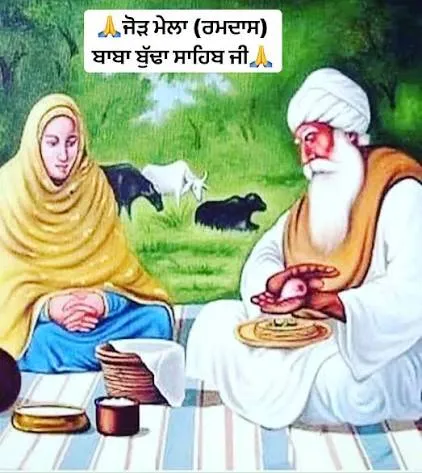
Please read the complete write-up. There is much to learn from it.**
Today, an important aspect of Baba Budha Sahib Ji's life is being shared with the Sangat—an aspect that has often received far less attention than it deserves.
Baba Budha Sahib Ji is frequently portrayed in pictures and popular historical narratives either breaking onions or blessing families with sons. There is nothing wrong in remembering such traditions; the Guru's house is indeed regarded as a place of countless blessings. However, presenting only one aspect of Baba Budha Sahib Ji's extraordinary life does not do justice to his complete personality.
Baba Budha Sahib Ji was not only an embodiment of seva and Simran; he was also remembered as a great warrior, an accomplished swordsman and an exceptional horseman.
Traditional accounts describe him as highly skilled in archery and in the use of weapons.
During his long life, Baba Budha Sahib Ji is said to have trained three Guru Sahibs and several other Sikhs in horsemanship and martial skills.
He was remembered as a fearless and highly accomplished warrior who could disarm an opponent with remarkable speed and skill.
## Training Sri Guru Arjan Dev Ji
At the request of Sri Guru Ram Das Sahib Ji, Baba Budha Sahib Ji taught the Fifth Guru, Sri Guru Arjan Dev Ji, horsemanship and Shastar Vidya.
A traditional account associated with the wedding of Sri Guru Arjan Dev Ji and Mata Ganga Ji describes an incident involving a ceremonial peg.
When Guru Arjan Dev Ji was asked by villagers to uproot the wedding peg, some mischievous young men are said to have cut part of a tree, shaped it like an enormous peg and fixed it deeply into the ground in place of an ordinary one.
The all-knowing Guru Arjan Sahib Ji approached on horseback with a spear in his hand and uprooted the entire piece of wood from its roots.
According to the account, the task required such force that Guru Sahib's horse died from the exertion.
The people of the area were astonished at Guru Sahib's martial ability and later sought forgiveness for their mischief.
## Training Sri Guru Hargobind Sahib Ji
When the Sixth Guru, Sri Guru Hargobind Sahib Ji, became old enough for advanced training, Sri Guru Arjan Dev Ji sent him to Baba Budha Sahib Ji to learn Shastar Vidya, horsemanship and worldly education.
Guru Hargobind Sahib Ji received martial training from Baba Budha Sahib Ji.
Later, when the time came for Guru Hargobind Sahib Ji to wear the two swords symbolising **Miri and Piri**, Baba Budha Sahib Ji personally placed the two swords upon Guru Sahib.
Sri Guru Hargobind Sahib Ji also arranged for his younger son, the future Sri Guru Tegh Bahadur Sahib Ji, to receive several years of training in horsemanship and martial skills from Baba Budha Sahib Ji.
Later, during the Battle of Kartarpur, Guru Tegh Bahadur Ji displayed such exceptional courage that Guru Hargobind Sahib Ji honoured him with the name and title associated with his mastery of the sword and bravery.
Baba Budha Sahib Ji is also remembered for training other members of the Guru's family and many Sikhs in horsemanship and Shastar Vidya.
Such was Baba Budha Sahib Ji.
## Words Attributed to the Six Guru Sahibs About Baba Budha Sahib Ji
**“I shall not remain hidden from you.” — First Guru**
**“What instruction can be given to one whose Guru is Nanak Dev?” — Second Guru**
**“You are a pillar of Sikhi.” — Third Guru**
**“It is difficult to find a supreme saint like you in this world.” — Fourth Guru**
**“You are a protector of the entire world.” — Fifth Guru**
**“There is none other like him; he is unique.” — Sixth Guru**
## The Family of Baba Budha Sahib Ji
Let us also learn about the family lineage of Brahm-Giani Baba Budha Sahib Ji.
Baba Budha Ji was born in the village of Kathunangal in the Amritsar region to Bhai Suggha Ji and Mata Gauran Ji.
His childhood name was **Bura**.
According to Sikh tradition, when Sri Guru Nanak Sahib Ji heard the young Bura speaking with extraordinary wisdom and maturity, Guru Sahib remarked that his understanding was like that of an elderly, wise person.
From this association, he came to be known as **Baba Budha Ji**.
Baba Ji married Bibi Miroa Ji, the daughter of a landholder from the village of Achal.
Baba Budha Sahib Ji had four sons:
Bhai Sudhari Ji, Bhai Bhikhari Ji, Bhai Mahimu Ji and Bhai Bhana Ji.
The three elder sons became occupied with their worldly responsibilities, while the youngest, Bhai Bhana Ji, continued serving the Guru's house and maintained the family's traditional role after Baba Budha Sahib Ji.
Bhai Bhana Ji performed the ceremonial tilak associated with the Guruship of Sri Guru Har Rai Sahib Ji, thus continuing the service of his lineage.
## Bhai Sarvan Ji and Bhai Jhanda Ji
After Bhai Bhana Ji and his elder son Bhai Jalal Ji passed away, Bhai Bhana Ji's younger son, Bhai Sarvan Ji, took a leading role in serving the Guru's house.
He served at the feet of Sri Guru Har Rai Sahib Ji for seven or eight years before passing away in Bikrami Samvat 1702.
Thereafter, Baba Budha Ji's great-grandson and Bhai Sarvan Ji's son, **Bhai Jhanda Ji**, stepped forward to continue this traditional duty and devoted himself wholeheartedly to the Guru's service.
Tradition records that Baba Budha Ji himself performed the Anand Karaj of this great-grandson.
When Bhai Jhanda Ji was born, Guru Ram Das Ji had visited Baba Budha Ji at Ramdas.
It is said that Guru Ram Das Sahib Ji initially considered naming the settlement Jhanda Nagar after Bhai Jhanda Ji, but at Baba Budha Ji's suggestion the place came to be associated with the name **Ramdas-Jhanda**, honouring Guru Ram Das Ji.
When Sri Guru Har Krishan Sahib Ji was installed upon the Guruship, Bhai Jhanda Ji performed the ceremonial tilak.
Bhai Jhanda Ji had also participated in battles alongside Sri Guru Hargobind Sahib Ji.
Some time after performing the Guruship ceremony of Sri Guru Har Krishan Sahib Ji, Bhai Jhanda Ji passed away.
## The Service of Bhai Gurditta Ji
After this, the fifth generation in Baba Budha Ji's lineage to continue this service was represented by **Bhai Gurditta Ji**.
Bhai Gurditta Ji lived through a particularly difficult period.
At the time, numerous claimants—traditionally described as twenty-two Manjis—were present at Bakala, and each wanted Bhai Gurditta Ji to perform the Guruship tilak in their favour.
Bhai Gurditta Ji remained firm and did not support any false claimant.
When Sri Guru Tegh Bahadur Sahib Ji was revealed as the true Guru, Bhai Gurditta Ji performed the ceremonial tilak of Guruship for Guru Tegh Bahadur Sahib Ji.
He then decided to remain with Guru Tegh Bahadur Sahib Ji and spent considerable time in Guru Sahib's company.
When Guru Tegh Bahadur Ji travelled onward from Kiratpur, Bhai Gurditta Ji returned to Ramdas.
Later, feeling a strong desire for Guru Sahib's company again, he travelled to Anandpur Sahib and rejoined Guru Tegh Bahadur Sahib Ji.
When Aurangzeb's authorities took Guru Tegh Bahadur Sahib Ji to Delhi, Bhai Gurditta Ji was also present.
After Bhai Mati Das Ji and Bhai Sati Das Ji were martyred, Bhai Gurditta Ji obeyed Guru Tegh Bahadur Sahib Ji's command and began returning toward Anandpur Sahib.
He reached the banks of the Yamuna River and, according to the account, entered deep meditation and left his physical body there in Bikrami Samvat 1732.
## Bhai Ram Koer Ji — Bhai Gurbakhsh Singh Ji
In the sixth generation after Baba Budha Sahib Ji arose a highly respected spiritual figure whose reputation spread widely and who was honoured by Hindus and Muslims alike.
His name was **Bhai Ram Koer Ji**.
After receiving Amrit from Sri Guru Gobind Singh Ji, he became known as **Bhai Gurbakhsh Singh Ji**.
He was approximately six years younger than Sri Guru Gobind Singh Ji.
Because he belonged to the lineage of Baba Budha Sahib Ji, tradition records that when he was only around two and three-quarter years old, he was given the honour of performing the ceremonial tilak connected with the Guruship of Sri Guru Gobind Singh Ji.
On one occasion, Mata Gujri Kaur Ji requested Guru Gobind Singh Ji to show her a fully realised Brahm-Giani.
Guru Gobind Singh Ji brought Bhai Ram Koer Ji before Mata Ji and said that, at that time, there was no greater Brahm-Giani than him.
Many other Sakhis are associated with Bhai Ram Koer Ji.
Tradition also attributes the work known as **“300 Sakhi”** to Bhai Ram Koer Ji, describing it as containing prophetic or future-related sayings.
It is said that when Guru Gobind Singh Ji prepared to travel toward Nanded Sahib, he instructed Bhai Ram Koer Ji to return to Ramdas.
Guru Gobind Singh Ji is traditionally said to have given him two blessings.
The first was that whenever Bhai Ram Koer Ji delivered Katha, Guru Sahib would spiritually reside upon his tongue and enable the narration.
The second was that whenever he longed for Guru Sahib's Darshan, he should wear his weapons and go out hunting, and Guru Sahib would grant him Darshan.
Bhai Santokh Singh Ji is described in tradition as having been connected with Bhai Ram Koer Ji and as having heard accounts of Guru history from him before later recording Sikh history in his writings.
## The Lineage and Management of the Ramdas Dera
After Bhai Ram Koer Ji passed away, his son Bhai Mehar Singh Ji became responsible for the property and management of the Ramdas Dera.
He managed the institution until Bikrami Samvat 1820.
After him, his son Bhai Sham Singh Ji became the successor.
Following Bhai Sham Singh Ji's death, his young son Bhai Kahan Singh Ji also passed away at a young age in the same year.
Bhai Kahan Singh Ji's son, Bhai Sujan Singh Ji, was still a child and was not yet capable of managing the property and administration.
By then, conflicts had begun among the emerging Sikh Misls and control of the Dera was taken over.
Soon, however, the mistake was recognised.
In order to preserve the historic legacy associated with Baba Budha Sahib Ji, management of the Dera was entrusted to a Mahant named Charan Das.
After Mahant Charan Das, the institution was managed successively by Mahant Brahm Prakash, Mahant Ram Prasad, Mahant Thakur Das and finally Mahant Raghubir Das.
They continued to manage the substantial property associated with Baba Budha Sahib Ji and maintained the Dera.
When the Akali movement arose, Mahant Raghubir Das handed over the complete management of the Gurdwara to the Akalis, or the Shiromani Gurdwara Parbandhak Committee.
Later, Baba Kharak Singh Ji worked tirelessly to develop Baba Budha Sahib Ji's historic site at Ramdas, including the Sarovar and Langar Hall, for the benefit of the Sangat.
## Bir Baba Budha Sahib Ji and Mata Ganga Ji
Bir Baba Budha Sahib Ji is also associated with the famous Sakhi of Mata Ganga Ji.
According to tradition, following the instruction of Sri Guru Arjan Sahib Ji, Mata Ganga Ji went to Baba Budha Sahib Ji to seek his blessings.
Baba Budha Sahib Ji blessed Mata Ganga Ji with a son.
The deeper understanding expressed in the tradition is that the blessing itself came through Sri Guru Arjan Sahib Ji, because Guru Sahib had personally directed Mata Ganga Ji to go to Baba Budha Sahib Ji, receive his happiness and seek his blessing.
The Gurus themselves are pleased when they cause the greatness of their Sikhs to be recognised.
Such is the blessed house of Sri Guru Nanak Sahib Ji.
**Please forgive any mistakes or shortcomings.
Servant — Zorawar Singh Tarsikka.**
Join the conversation
Sign in to comment or join the discussion.
Loading comments…