

Shaheedi Diwas Bhai Sukhdev Singh (Sukha) Bhai Harjinder Singh (Jinda)
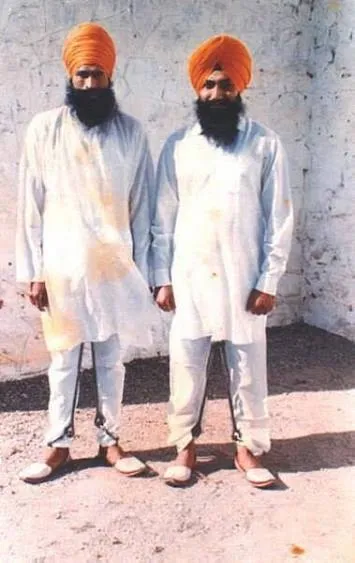
**Bhai Harjinder Singh Jinda and Bhai Sukhdev Singh Sukha — Sikh Warriors
(Executed on 9 October 1992)**
**“When even the adversary acknowledged the courage and resolve of the Singhs”**
Referring to words attributed to Delhi Police Commissioner Ved Marwah, the article states that, despite being a comparatively young community in the long history of humanity, the Sikh community takes pride in having produced countless members of the Khalsa who are remembered as shining examples for those who seek justice, truth, and resistance to oppression.
The article presents Bhai Harjinder Singh Jinda and Bhai Sukhdev Singh Sukha as two prominent sons of the Khalsa Panth established by Guru Gobind Singh Ji, and remembers them for what it describes as extraordinary courage and sacrifice.
It argues that General Vaidya, who commanded large military forces and was associated with the military operation at the Akal Takht Sahib, eventually faded from popular memory, while Jinda and Sukha became enduring figures in sections of Sikh historical memory.
The article further claims that even their opponents acknowledged their courage and fearlessness.
It describes the two men as possessing the roar of lions in battle and says that they faced the journey toward execution while remaining in what the author portrays as a spiritually elevated state.
According to the article, the prospect of death did not frighten them. Their faces are described as radiant and composed.
Their humility is also emphasised in the account, which says that they even embraced the executioner, viewing him as the person carrying out the final act leading them toward death.
As Bhai Sukha and Bhai Jinda approached the gallows while raising the Sikh jaikara “Bole So Nihal,” the author presents the moment in deeply spiritual and heroic imagery.
When discussing the courage and conduct of Sikhs in the eighteenth century, the historian Qazi Nur Muhammad, who accompanied Ahmad Shah Abdali, is often mentioned.
The article notes that Qazi Nur Muhammad had initially used the Persian word “sag,” meaning dog, for the Sikhs, but later, after observing their conduct in battle, reportedly wrote words to the following effect:
“Do not call these Sikhs dogs; they are real lions. How can one call a man a dog when he fights like a lion on the battlefield? O warriors of the sword, if you wish to learn the techniques of battle and the use of the sword, learn from them. They confront the enemy like heroes and then withdraw with great skill and safety.”
The article argues that praise from an adversary is especially significant when judging courage and conduct.
Discussing the violent Khalistan-related conflict of the late twentieth century and the large number of Sikhs who died during that period, the writer presents Jinda and Sukha as examples of courage, resolve, and fearlessness in the face of death.
### A Brief Biography of Bhai Harjinder Singh Jinda
Bhai Harjinder Singh Jinda was born to Mata Gurnam Kaur and Gulzar Singh Ji, whom the article describes as hardworking Sikhs of high spirits and strong faith.
He had two elder brothers, Nirbhail Singh and Bhupinder Singh, and one sister, Bibi Balwinder Kaur.
Bhai Harjinder Singh was born on 4 April 1962.
He received his primary education in his village, Gadli, in Amritsar district.
After completing Class 10 at Gehri Mandi and Class 12 at Jandiala Guru, he enrolled at Khalsa College, Amritsar, for higher education.
He was studying in the second year of his B.A. when the events of 1984 took place.
The article describes the June 1984 military operation by stating that Sikh devotees gathered at Sri Darbar Sahib during the martyrdom observance of Sri Guru Arjan Dev Ji came under fire involving guns, bombs, artillery, and tanks.
It further states that Sri Akal Takht Sahib was heavily damaged, that other Gurdwaras came under military control, and that Sikh youths in villages were subjected to security operations.
According to the article, these events deeply affected Harjinder Singh Jinda, leading him to leave his studies and join the Sikh militant struggle.
While Sri Darbar Sahib remained under military control, the article says that Jinda joined people from his village and nearby Sikh congregations in a march toward the complex.
According to the account, the march was stopped at military checkpoints, participants were assaulted, and they eventually returned home distressed and frustrated.
Harjinder Singh Jinda then went to his maternal relatives’ village, Chak Bai H., in Sri Ganganagar.
There he met his maternal cousin Baljinder Singh Raju and Raju’s friend Bhai Sukhdev Singh Sukha of village 16 F.
The article states that they resolved to retaliate for what they regarded as the desecration of Sri Akal Takht Sahib, Sri Harmandir Sahib, and other Sikh religious sites, as well as for actions taken against the Sikh community.
Bhai Raju was later arrested by police.
After hearing reports of alleged torture inflicted upon him, the article says that Jinda and Sukha became even more determined and angry.
One of the subsequent actions attributed to Jinda is described as follows:
On 31 July 1985, Congress politician Lalit Maken was killed. Bhai Harjinder Singh Jinda, Bhai Sukhdev Singh Sukha, and Bhai Ranjit Singh Gill were named in connection with the killing.
Bhai Ranjit Singh Gill was arrested on 14 May 1987 in New Jersey, United States, with assistance from Interpol.
A lengthy extradition process followed, and in 2000 he was extradited to India, where he was subsequently sentenced.
**The remaining part will continue in the next section.**
Join the conversation
Sign in to comment or join the discussion.
Martyrdom Day of Bhai Sukhdev Singh (Sukha) and Bhai Harjinder Singh (Jinda) — Part 2
Another Congress politician accused of playing an important role in the anti-Sikh violence that took place in Delhi and other Indian cities in 1984 was Arjun…
Continue in the Nitnama app
Loading comments…