

Birth of Bhai Suthra Shah Ji
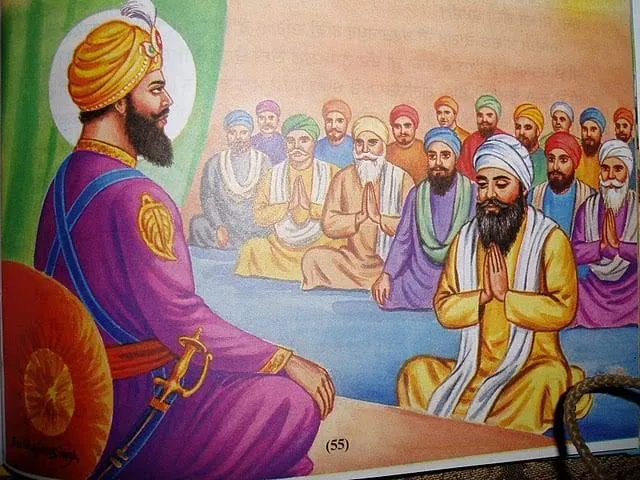
Bhai Suthra Shah Ji was born on November 10. Let us take a brief look at the history and life of this remarkable Sikh personality.
Maulvi Noor Ahmad Chishti wrote in his book Tahqiqat-e-Chishti that Suthra Chand originally belonged to the Madwara community of the Khatri caste. His maternal relatives belonged to the Nand Khatri community. His birthplace was the village of Behrampur in the Baramulla region of Kashmir, near Srinagar.
When he was born, he already had teeth in his mouth. Considering this an inauspicious sign, his parents abandoned him outside their home.
While Sri Guru Hargobind Sahib Ji was returning from Kashmir, he heard the cries of a child along the way.
Guru Sahib remarked, "What a beautiful child is lying here! Pick him up, take care of him, and arrange for his upbringing."
Because Guru Sahib used the word "Suthra" to describe the child, he came to be known by that name.
When the child reached the age of five, his parents regretted their decision and took him back home.
After the death of his parents, Bhai Suthra Shah Ji donated all his family's wealth and possessions to charitable causes and returned to the holy presence of Guru Sahib.
Upon seeing him, Guru Sahib said, "Welcome, Suthra Shah Ji."
From that day onward, people began calling him Bhai Suthra Shah.
Bhai Suthra Shah Ji was a cheerful and humorous person by nature. Through his devoted service to Guru Sahib, his words were believed to have acquired spiritual power, and whatever he said would come true.
He preached Sikh teachings in a unique, humorous, and thought-provoking manner.
An Incident at Guru Sahib's Court
Once, a large gathering had assembled in Guru Sahib's court. Because of the crowd, people were not allowing anyone to move forward.
Bhai Suthra Shah Ji filled a sack with broken pieces of earthen pots and began walking toward Guru Sahib, announcing, "Make way! I have an offering to place at Guru Sahib's feet."
When he reached Guru Sahib, instead of bowing before Guru Sahib, he repeatedly bowed before the sack.
Guru Sahib asked, "Suthra Shah, what are you doing?"
He replied, "Maharaj! It is only because of this sack that I was able to have your darshan. Otherwise, who would have allowed me to reach your feet?"
Upon hearing this, Guru Sahib ordered that all offerings and food supplies should be delivered directly to the langar and that no one should be prevented from coming for darshan.
Respect for Guru Sahib's Teachings
On another occasion, Guru Sahib was delivering a spiritual discourse when Bhai Suthra Shah Ji turned his back toward him.
The congregation considered this disrespectful.
When Guru Sahib asked him why he had turned around, Bhai Suthra Shah Ji replied:
"Maharaj! At first, I faced your words directly and endured their powerful impact upon my face. But now I no longer have the strength to bear them. Therefore, I turned my back so that the force of your words might strike there instead. I do not know how the congregation manages to bear the arrows of your teachings."
On another occasion, Bhai Suthra Shah Ji demonstrated through his gestures that a holy man named Sital Das was peaceful only in name, while inwardly he was burning with anger.
During the reign of Aurangzeb, Bhai Suthra Shah Ji displayed remarkable courage. He visited Delhi and, on several occasions, openly challenged the claims of religious scholars, qazis, and even Aurangzeb himself.
Standing before Aurangzeb, he boldly remarked, "Do not lose heart. This too is an expression of divine joy."
Following Guru Sahib's instructions, Bhai Suthra Shah Ji spread the teachings of Sikhism throughout the hill states of Punjab, Kashmir, and as far as Balkh and Bukhara.
The historical work Dabistan-i-Mazahib also mentions that Suthra and Do Sifa spread Sikh teachings across distant regions in their distinctive ways.
Four prominent followers of Bhai Suthra Shah Ji's tradition were Bhai Jado, Bhai Jhujha Shah, Bhai Razal Shah, and Andher Shah.
Bhai Suthra Shah Ji composed several poetic verses and folk couplets that were deeply meaningful and became popular among the people.
His poetry conveyed spiritual teachings in simple and direct language.
For example:
"Listening to people's tales serves no useful purpose. If you wish to accomplish your work, remember the Almighty early in the morning."
He also composed a beautiful poetic tribute in praise of Sri Guru Hargobind Sahib Ji, the master of Miri-Piri.
The meaning of the verse is:
"He is the servant of a great master, perfect in his actions. His horse is worth a fortune, and he is a brave warrior armed with weapons. He does not receive wounds from behind but faces his enemies with courage and pride. He loves pure milk and does not consume inferior food. All descriptions fall short; only Your name is complete."
Bhai Suthra Shah Ji lived a long life and, according to this account, passed away during the time of Sri Guru Gobind Singh Ji.
Other prominent followers of his tradition included Bhai Jhagar Shah, Bhai Mushtaq Shah of Lahore, and Bhai Haro Shah of Batala.
Two places associated with him are mentioned in Sri Amritsar: one at Chowk Chhatti Khoohi and another near Khazane Da Katra.
Other places associated with his tradition are also said to exist in Noormahal, Sindh, Jaunpur, and Afghanistan.
Some Historical Sakhis of Bhai Suthra Shah Ji
First Sakhi: Slapping Members of the Congregation During Kirtan
Once, Guru Sahib's court was in session, and Bhai Suthra Shah Ji was sitting among the congregation, listening to the sacred kirtan.
Suddenly, he stood up, slapped a few people sitting in the congregation, and ran away.
News of the incident spread rapidly.
People began saying that Bhai Suthra Shah Ji had crossed all limits by slapping members of Guru Sahib's congregation while they were listening to kirtan.
Bhai Suthra Shah Ji was very close to Guru Sahib, who loved him dearly.
Some people were jealous of this close relationship.
They encouraged others to complain, saying that Guru Sahib had spoiled Bhai Suthra Shah Ji by showing him too much affection, which was why he behaved in such a manner.
Meanwhile, seeing the growing anger among the congregation, Bhai Suthra Shah Ji disappeared and did not return for several days.
When Guru Sahib summoned him, he appeared with folded hands.
Guru Sahib asked him about the accusations.
Bhai Suthra Shah Ji replied, "Maharaj! Why should I not slap them? They were doing something that deserved correction."
When everyone asked him to explain, he said:
"These people were sitting in the holy congregation, chatting and laughing among themselves. The court of the Lord of countless universes was being held, yet instead of listening to the sacred Shabad, they were busy with meaningless conversations."
"Not only were they leading their own lives in the wrong direction, but they were also disturbing the rest of the congregation. That is why I slapped them."
Upon hearing the explanation, Guru Sahib expressed affection toward Bhai Suthra Shah Ji and reprimanded those who had acted out of jealousy.
Second Sakhi: A Lesson for the Guards
On another occasion, the guards stationed outside Guru Sahib's court decided among themselves that they would not allow Bhai Suthra Shah Ji to enter.
When he arrived to seek Guru Sahib's darshan, they stopped him.
They told him, "Guru Sahib has ordered that you are not allowed inside."
Bhai Suthra Shah Ji became deeply distressed.
His love for Guru Sahib was so intense that living even a moment without darshan felt unbearable.
Just as a fish cannot survive without water, Bhai Suthra Shah Ji could not bear separation from Guru Sahib.
He gathered broken pieces of earthen pots, placed them in a bundle, lifted it onto his head, and approached the guards.
He said, "Move aside quickly! I have brought an offering for Guru Sahib."
However, the guards still refused to let him pass.
They imposed a condition: whatever gifts or blessings he received from Guru Sahib, half would belong to them.
Bhai Suthra Shah Ji immediately accepted the condition.
When he entered Guru Sahib's court and placed the bundle before him, Guru Sahib asked about it.
Bhai Suthra Shah Ji truthfully explained everything that had happened.
Guru Sahib was pleased and said, "Bhai Suthra, ask for whatever you wish."
Bhai Suthra Shah Ji replied, "Maharaj! I wish to receive one hundred lashes."
Guru Sahib asked why he had made such an unusual request.
Bhai Suthra Shah Ji answered, "Maharaj! Half of these lashes belong to the guards. They allowed me to enter only after I agreed to give them half of whatever I received from you."
Upon hearing this, Guru Sahib summoned the guards and reprimanded them.
In this way, Bhai Suthra Shah Ji used unusual and humorous methods to guide misguided Sikhs toward the right path.
Third Sakhi: Testing the Anger of a Yogi
Once, a yogi came to meet Guru Sahib.
The yogi had covered his entire body with ashes.
At that time, Bhai Suthra Shah Ji was performing the service of waving the chaur over Guru Sahib.
While performing this seva, he began teasing the yogi by making strange and unpleasant facial expressions.
For some time, the yogi watched silently and tolerated the behavior.
However, Bhai Suthra Shah Ji continued making faces, showing his teeth, and provoking him.
Eventually, the yogi lost his temper.
He picked up his iron tongs and rushed toward Bhai Suthra Shah Ji to strike him.
Seeing this, Bhai Suthra Shah Ji ran away.
When Guru Sahib learned what had happened, he called Bhai Suthra Shah Ji and asked him why he had behaved that way.
Bhai Suthra Shah Ji replied:
"Guru Sahib! I wanted to see whether this yogi had applied ashes only to his body or whether his mind had also become free from worldly passions."
"But Maharaj, his mind is still burning with anger. Therefore, his outward appearance is merely a display of false spirituality."
Fourth Sakhi: Turning His Back Toward the Kirtan Singers
Once, the Ragi Singhs were performing kirtan in Guru Sahib's court.
Bhai Suthra Shah Ji sat with his back facing the kirtan singers.
Some Sikhs complained to Guru Sahib that he had insulted the sacred kirtan.
Guru Sahib summoned him and asked why he had done so.
Bhai Suthra Shah Ji replied:
"Guru Sahib! Today, through their sacred hymns, the Ragi Singhs struck my flawed life with such powerful spiritual messages that I could no longer bear them."
"Therefore, I turned my back."
"Guru Sahib, you are guiding Sikhs toward such an elevated spiritual life, yet we continue to remain attached to our faults and weaknesses."
Fifth Sakhi: The Lesson Behind Harsh Words
Once, Bhai Suthra Shah Ji used abusive language toward members of Guru Sahib's congregation and then ran away.
The entire congregation became angry.
People complained that Guru Sahib had shown him too much affection and that he had now crossed all limits by insulting the Guru's congregation.
They decided to report the incident to Guru Sahib.
Bhai Suthra Shah Ji, sensing the anger, stayed away from the congregation for several days.
Eventually, some Sikhs found him and brought him before Guru Sahib.
Guru Sahib asked why he had used abusive language.
Bhai Suthra Shah Ji replied, "Guru Sahib! They are all lying. I did not abuse anyone."
The Sikhs became even more upset.
They said, "Look, Maharaj! First he insulted us, and now he is lying in your presence."
Bhai Suthra Shah Ji asked, "Tell me, what abusive words did I use?"
One person said, "You called me a bastard."
Another said, "You called me an illegitimate person."
One by one, everyone recalled the insulting words directed at them.
Bhai Suthra Shah Ji then folded his hands and requested:
"Guru Sahib! Now please ask these people what teachings you delivered on the day I supposedly insulted them."
Upon hearing this, everyone lowered their heads in embarrassment.
Bhai Suthra Shah Ji continued:
"All of you clearly remember the unpleasant words I spoke, yet none of you remembers the sacred teachings delivered by Guru Sahib that day."
"This proves that you are customers of glass rather than gold."
In other words, people often remember worthless remarks while forgetting valuable spiritual teachings.
The Moral of This Sakhi
These shortcomings can still be found among us today.
We may forget Guru Sahib's Hukamnama or the sacred Shabads sung by the Ragi Singhs, but we remember very clearly if there was too little salt in the dal served at the langar.
We notice whether a Ragi Singh was wearing a ring or whether someone was wearing their gatra in a particular way.
Instead of focusing on the spiritual teachings being shared at the Gurdwara, we often become occupied with finding faults in its management or other people's appearances.
This suggests that some people visit the Gurdwara not to improve themselves as Sikhs but to establish their own importance or influence.
They want others to consider them knowledgeable and vigilant Sikhs.
Therefore, whenever we visit the Guru's house, we should direct our attention toward Guru Sahib's teachings rather than criticizing other people's clothing, behavior, or minor shortcomings.
Poetry of Bhai Suthra Shah Ji
The following verses reflect the satirical, spiritual, and often sharply critical style associated with Bhai Suthra Shah Ji.
1. He Who Keeps a Dog
He who keeps a dog is himself called a dog.
A grandson who depends upon his maternal grandfather is called a dog.
A brother who lives dependent upon his sister is called a dog.
A son-in-law who depends upon his in-laws is called a dog.
But look for an even greater one:
The father-in-law who follows his son-in-law everywhere.
Whoever follows others out of greed,
That person is the real dog, wandering from place to place.
2. The Name of Nanak Shah
The name of Nanak Shah is the truth of this life.
Without the Divine Name, no other words hold lasting meaning.
This is the path of truth; this is the pure and righteous way.
People may call Suthra foolish or eccentric.
But the Lord has placed His guiding rein upon us.
We dance as He makes us dance, for there is no other support.
Sons and daughters become bonds of attachment in life.
We are Suthra Shah, fearless and ready to sacrifice ourselves.
The King of Kings has blessed us with the gift of freedom from worry.
O Suthra, when your final moment arrives, place your hand upon your chest.
Depart laughing and rejoicing upon that mysterious path.
Suthra has received a priceless treasure from Nanak Shah.
3. To Frighten People
Question:
Have you adopted the appearance of a holy man merely to frighten people?
Do you call yourself a Baba so that you can eat without working?
As more and more sweets are offered, your appetite continues to grow.
You freely distribute blessings without worrying about what comes afterward.
Answer:
O Suthra! If the Baba truly possessed wisdom, why would he consume offerings in this manner?
But what can the poor Baba do if the Almighty has scattered his livelihood in this way?
Whatever the Almighty provides, one must accept and consume.
Everything happens according to the will of the Supreme Lord.
4. Daughters, Sons, and Family Life
Daughters are compared to raiders, sons to nooses, and a wife to a well of sorrows.
O Suthra! Only a rare devotee of the Lord can escape this difficult cycle.
The burdens of the household increase, yet people call the occasion a wedding procession.
As the household becomes increasingly burdened, people continue offering congratulations.
A wife arrives, and married life begins.
People announce that a separate household has been established.
The man becomes a bridegroom.
On this side is the Ganges, on the other side is the Ganges, and between them are you and I.
O Suthra! People remain entangled in matters of giving, receiving, and worldly obligations.
5. There Stand the Wife, Sons, and Brothers
There stand the wife, sons, and brothers.
Elephants, horses, possessions, and wealth—none of these will accompany you after death.
When that moment arrives, which deity will come to your aid?
One who did not remember the Divine Source earlier cannot make up for it at the final moment.
Look at those who follow only their own desires.
They suffer the consequences of their actions and face many punishments.
6. The Drums Beat, and the Household Is Plundered
The drums beat, the household is emptied, and people call it a wedding.
One who has not sown the seed of devotion to the Lord will ultimately face disgrace.
On the day when the account of one's deeds is demanded, one will stand pleading humbly for mercy.
O Suthra! Those who wander away from the righteous path will experience great suffering.
7. As the Bonds of Family Increase
As the bonds of family continue to multiply,
A person cries and laments ever more loudly.
This family life is described as a house of sorrows.
Escape before becoming trapped within it.
Listen to the call of the saints.
Understand that this mortal body is also subject to decay.
A man wears the ceremonial wedding crown and imagines himself a king.
But if an opportunity comes, escape the bondage.
Such are the congratulations associated with worldly family life, which people celebrate so happily.
O Suthra! They spend their lives making meaningless noise, like dogs barking endlessly.
Join the conversation
Sign in to comment or join the discussion.

Loading comments…