

Jyoti jyot Gurpurab Sri Guru Gobind Singh ji
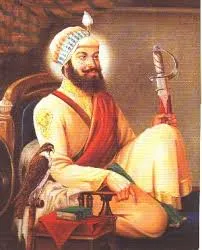
Sri Guru Gobind Singh Ji Maharaj — The Kingly Saint (Badshah Darvesh)
Muhammad Latif writes:
"Guru Gobind Singh, seated on the religious throne, appeared as a spiritual guide; seated on a royal throne, as the Emperor of Emperors; on the battlefield, as a mighty warrior; and sitting among the congregation, as a humble fakir."
Although Guru Gobind Singh Ji maintained royal grandeur and magnificence, in his heart and mind he always remained a humble fakir.
Perhaps that is why he is remembered as Badshah Darvesh — the Kingly Saint.
He shaped, refined, and developed every aspect of humanity in such an extraordinary way that those who saw, heard, and learned about him were left amazed.
He was tall and majestic, with a radiant face and such brilliance in his eyes that people were dazzled by his presence.
He was an exceptional horseman and a lover of the open natural world.
Whenever he entered his royal court, he wore magnificent garments, adorned himself with fine weapons, and placed a royal plume upon his turban, just like an emperor.
Whenever he went hunting, he rode a beautiful and swift horse. In his left hand, he carried a falcon with its jesses, while mounted Singhs accompanied him.
He was a great military commander, a scholar of the highest order, an extraordinary literary figure, a lover of Gurbani Kirtan, Sarbans Dani (the one who sacrificed his entire family), the giver of Amrit, and the embodiment of devotion and strength.
He was a courageous warrior, a master of both weapons and sacred knowledge, a Saint-Soldier, Sahib-e-Kamal (the Master of Perfection), Mard Agammara (an extraordinary and incomparable man), and a destroyer of evil.
He possessed courage, faith, patience, determination, and the spirit of Chardi Kala.
He was also an ideal householder, a devoted son, a loving father, and a virtuous husband.
Beyond this, my words come to an end, and my pen becomes incapable of describing his greatness.
I can only say:
How many of Your countless virtues can I describe and sing?
O Lord, You are the treasure of all virtues.
He was a fearless and courageous warrior whose principle was to fear no one and intimidate no one.
Whether facing the hill kings or the rulers of the Mughal Empire, he never believed in compromising with oppression, injustice, or tyranny.
Sufi Kibriya Khan expressed his admiration through these poetic lines:
O Tenth Master, how can I describe the great kindnesses you bestowed?
You established the pure Khalsa Panth and removed the divisions of caste.
In service to your homeland, you sacrificed both your father and your beloved sons.
Bhai Nand Lal Ji and Guru Gobind Singh Ji
If one wishes to see all the extraordinary qualities of Sri Guru Gobind Singh Ji described in one place, one should turn to Ganjnama.
This work contains the poetry of Bhai Nand Lal Ji, who was among the 52 poets associated with Guru Gobind Singh Ji.
Bhai Nand Lal Ji wrote that the personality of Guru Gobind Singh Ji resembled nine blazing torches illuminating the heavens and removing the darkness of falsehood and untruth.
After describing more than 200 virtues of Guru Sahib, Bhai Nand Lal Ji was eventually left speechless.
He finally expressed his devotion with these words:
"All I can say is that I wish to place my head at Your feet and breathe my last there."
Bhai Nand Lal Ji was so deeply devoted to every virtue of Guru Sahib that he could neither see nor think of anything beyond his beloved Guru.
How Bhai Nand Lal Ji reached Anandpur Sahib
At one time, Bhai Nand Lal Ji taught Persian to Prince Muazzam, the son of Aurangzeb, who later became known as Bahadur Shah.
Bhai Nand Lal Ji was an outstanding scholar of the Persian language.
On one occasion, he visited Aurangzeb's court to translate a Persian letter.
He translated it so beautifully and skillfully that even Aurangzeb was astonished.
The emperor asked his courtiers about the identity of this brilliant scholar.
When Aurangzeb learned that Nand Lal was a Hindu, he instructed his courtiers either to convert him to Islam or to have him killed.
According to the account, Aurangzeb could not tolerate the thought of such an exceptionally talented scholar bringing honor to another religion.
News of this order eventually reached Aurangzeb's son.
The prince informed Bhai Nand Lal Ji about the danger.
Nand Lal Ji became deeply worried and asked:
"I love both my life and my religion. Is there any place where I can protect both?"
Aurangzeb's son replied:
"If you want to protect your life and your faith, go to Anandpur."
That very night, with the help of his Muslim administrator and follower, Bhai Nand Lal Ji managed to escape from the fort at Agra.
He eventually reached Anandpur Sahib.
Guru Sahib assigned Bhai Nand Lal Ji the Seva of washing utensils
Guru Gobind Singh Ji was very pleased to see Bhai Nand Lal Ji's extraordinary knowledge and scholarship.
However, to ensure that pride did not develop in his heart, Guru Sahib assigned him the humble Seva of washing utensils in the Langar.
Initially, Bhai Nand Lal Ji did not like this duty.
He was astonished and thought to himself:
"Guru Sahib should have asked me to recite poetry or present some of my writings. Instead, he has assigned me to wash dishes!"
Nevertheless, the Guru's command had to be obeyed.
So Bhai Nand Lal Ji began washing the utensils.
Gradually, as the dishes became cleaner, the pride within his heart also began to disappear.
After some time, Guru Sahib appointed him the head of one of the Langar kitchens.
Guru Sahib tests the Langar arrangements
One day, Guru Gobind Singh Ji decided to inspect how the Langar kitchens were being managed.
He disguised himself and visited the different kitchens.
At each kitchen, he said:
"I have not eaten for two days. I have walked a very long distance and am extremely hungry. Please give me something to eat."
However, it was not the scheduled time for Langar.
Each kitchen supervisor gave essentially the same response:
"It is not time for Langar yet. The food is not ready. Please come back after a while."
Finally, Guru Sahib arrived at the Langar managed by Bhai Nand Lal Ji.
He said:
"I have walked from a very distant place. I am exhausted and have not eaten anything for two days. If you have something to eat, please give it to me."
Bhai Nand Lal Ji welcomed the visitor with great love and respect.
He respectfully seated him on a cot.
To relieve his tiredness, Nand Lal Ji washed his feet with warm water.
Then he said:
"Please rest for a little while. I will prepare whatever food I can make quickly and bring it to you."
Bhai Nand Lal Ji prepared whatever food was available and served it with deep affection, kindness, and respect.
After eating, Guru Sahib removed the cloth covering his face.
He revealed his identity and said:
"Nand Lal, I am very pleased with you. Ask me for anything you desire."
What did Bhai Nand Lal Ji ask for?
He replied:
"Please grant me a place at Your holy feet. I desire nothing more than this."
The story of the stones and the river
On another occasion, Guru Gobind Singh Ji was walking with Bhai Nand Lal Ji and several other Sikhs.
While walking beside a river, Guru Sahib picked up a stone and threw it into the water.
He then asked the Sikhs:
"Why did this stone sink?"
The Sikhs replied:
"Guru Sahib, a stone is heavy, so it sinks in water."
After walking a little farther, Guru Sahib picked up another stone and threw it into the river.
Once again, he asked:
"Why did this stone sink?"
The Sikhs gave the same answer.
A little later, Guru Sahib picked up a third stone, threw it into the river, and repeated the question.
After hearing the same question again and again, one Sikh became slightly irritated.
He said:
"Patshah, what are you doing? You keep picking up stones, throwing them into the river, and asking the same question. You already know that stones are heavy, and that is why they sink."
For the fourth time, Guru Sahib picked up a stone and threw it into the river.
But this time, instead of asking the other Sikhs, he turned toward Bhai Nand Lal Ji.
"Nand Lal, why did this stone sink?"
Bhai Nand Lal Ji remained silent.
Guru Sahib repeated:
"Nand Lal, I am asking you. Why did the stone sink?"
Tears filled Bhai Nand Lal Ji's eyes.
With deep love and devotion, he replied:
"Patshah, I did not see the water, nor did I see the stone. All I know is that whatever slips from Your hand is destined to sink."
Such was the depth of Bhai Nand Lal Ji's faith, love, and devotion toward Guru Sahib.
After hearing this remarkable answer, Guru Sahib asked Nand Lal Ji to request a blessing.
Bhai Nand Lal Ji replied:
"What could I possibly ask for? In Your face, I behold the entire universe, and in Your hair, I see both this world and the world beyond. What more could I ever desire?"
Yet Guru Sahib again encouraged him to ask for something.
Bhai Nand Lal Ji then expressed a beautiful wish:
"I have only one request. When I die, may the ashes of my body touch no one's feet except Yours."
After this, Bhai Nand Lal Ji never willingly separated from Guru Sahib.
He remained with him until Guru Gobind Singh Ji personally instructed him to return home when the fort of Anandpur was being evacuated.
Guru Sahib's final instructions to Bhai Nand Lal Ji
When the time came for Bhai Nand Lal Ji to leave Guru Sahib, tears filled his eyes.
He said:
"Patshah, I also wish to receive Khande di Pahul, become a Singh, and join the Khalsa.
Even if I can do nothing else, I would like to stand outside the tent of my beloved Guru and guard it."
Upon hearing this, Guru Gobind Singh Ji placed a pen in his hand.
Then Guru Sahib said:
"Let this pen move like the sword of a brave warrior. Those who are destined to wield the sword will wield it, and you shall wield the pen."
"There is more power in this pen than in the arms of a soldier.
Let this pen teach people goodness, righteousness, remembrance of the Divine, and noble conduct.
This is my command to you."
Guru Sahib then instructed Bhai Nand Lal Ji to return to Multan.
The poetry of Bhai Nand Lal Ji in praise of Guru Gobind Singh Ji
The following lines emerged from Bhai Nand Lal Ji's pen in praise of his beloved Guru. The Persian expressions are presented in transliteration, following the wording of the Punjabi source.
Nasar-o-Mansoor Guru Gobind Singh
Ezdi Manoor Guru Gobind Singh
Haq Haq Manzoor Guru Gobind Singh
Jumla Faiz-e-Noor Guru Gobind Singh
Haq Haq Agah Guru Gobind Singh
Shah-e-Shahanshah Guru Gobind Singh
Khalse Be Deena Guru Gobind Singh
Haq Haq Aaina Guru Gobind Singh
Haq Haq Andesh Guru Gobind Singh
Badshah Darvesh Guru Gobind Singh
The rest in the next part.
Join the conversation
Sign in to comment or join the discussion.
Joti Jot Gurpurab of Sri Guru Gobind Singh Ji — Part 2
Sri Guru Gobind Singh Ji was one of the greatest personalities in the history of Hindustan (India). His love for humanity, his noble spirit, and the…
Continue in the Nitnama app
Loading comments…