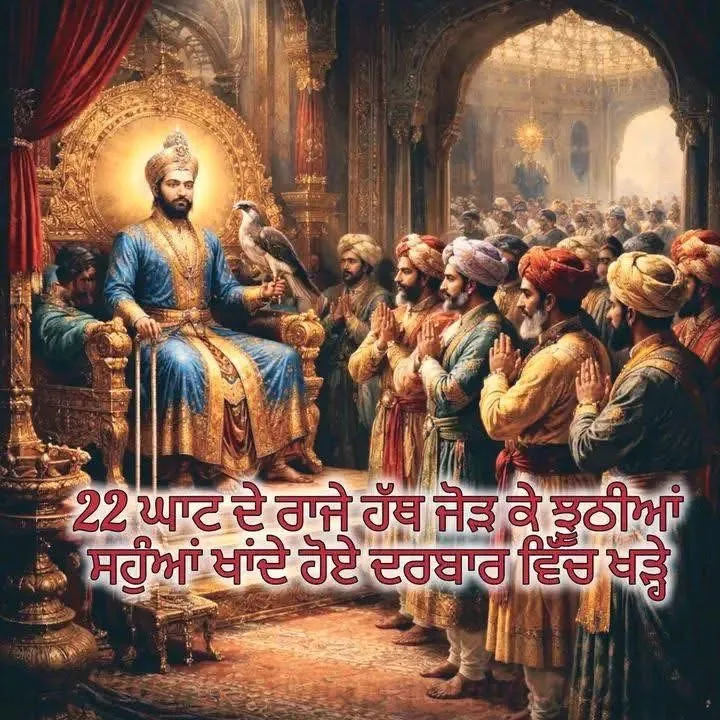
Among the line of Sikh martyrs, the martyr being remembered here is a priceless jewel of the Battle of Chamkaur Sahib—Bhai Sangat Singh. His greatness is further magnified by the honor bestowed upon him by the Tenth Guru, Sri Guru Gobind Singh Ji, who allowed him to wear the Guru’s sacred plume (kalgi) on his head. The life history of Bhai Sangat Singh Ji reveals that he spent his entire life in devoted service at the feet of Guru Gobind Singh Ji. From a young age, he came to Anandpur Sahib and acquired exceptional mastery in weaponry, marksmanship, and spear fighting, clearly demonstrating that he had fully prepared himself for battle. Before the Battle of Chamkaur Sahib, Bhai Sangat Singh Ji participated in several battles. He displayed remarkable valor alongside Sahibzada Baba Ajit Singh Ji during the liberation of Bassi Kalan, the Battle of Bhangani, the battle of Agampura, and the battle at the Sarsa River. Guru Gobind Singh Ji had complete faith in Bhai Sangat Singh Ji’s bravery and loyalty and held him in high esteem. Historical accounts state that after leaving Anandpur Sahib, the rulers broke their oaths and launched a sudden attack on the Guru. Fierce battles ensued, and Sikh warriors bravely confronted the Mughal forces. While crossing the Sarsa River, the Guru’s family became separated. Guru Gobind Singh Ji reached the mud fortress of Chamkaur with his two elder Sahibzadas and forty Singhs. The Mughal army, numbering in the hundreds of thousands, surrounded the fortress. On this land, an unparalleled battle was fought—forty hungry and exhausted Singhs against an enormous enemy force. In this battle, Sahibzada Baba Ajit Singh Ji, Sahibzada Baba Jujhar Singh Ji, and many Singhs attained martyrdom while fighting valiantly. As night fell and the battle ceased, only a few Singhs remained inside the fortress. Everyone knew it could be their final night, yet each Sikh was filled with a desire to sacrifice himself for the Guru. Concern arose that if Guru Gobind Singh Ji were martyred there, the tyrants would suppress the Khalsa once again. However, if the Guru survived, he would continue to guide and revive the Panth even in the darkest times. Thus, it was deemed essential for the Guru to escape safely. It was decided that Bhai Daya Singh Ji, Bhai Dharam Singh Ji, and Bhai Man Singh Ji would accompany the Guru. Among the remaining Singhs, Bhai Sangat Singh Ji closely resembled Guru Gobind Singh Ji. The Guru embraced him, honored him as his beloved Sikh, adorned him with his own kalgi, and bestowed upon him his weapons and attire. The Guru instructed Bhai Sangat Singh Ji to sit at the Guru’s position after his departure, dressed as the Guru, confront the Mughal forces fearlessly, and not allow himself to be captured alive, but to attain martyrdom while fighting. Mistaking Bhai Sangat Singh Ji for Guru Gobind Singh Ji, the Mughal forces showered him with arrows. Bhai Sangat Singh Ji fought valiantly with sword, arrows, and spears, inflicting heavy losses upon the enemy. Even when wounded, he continued chanting victory slogans until his final breath, perfectly fulfilling the Guru’s command. Ultimately, he embraced martyrdom in complete devotion to the Guru’s will. Thus, Bhai Sangat Singh Ji proved that sacrificing one’s life for faith while obeying the Guru’s command is the duty of true warriors. Today, he holds a place of great honor and reverence in Sikh history. His life exemplifies unwavering devotion to the Guru and steadfast commitment to righteousness. In today’s world, where humanity is caught in a blind race of materialism and drifting away from values, it becomes even more essential to look upon personalities like Bhai Sangat Singh Ji as role models and draw inspiration from their lives. It is also the duty of parents to educate children about such great martyrs, so they may grow into virtuous individuals and walk the path of life with purpose and success.
Please log in to comment.