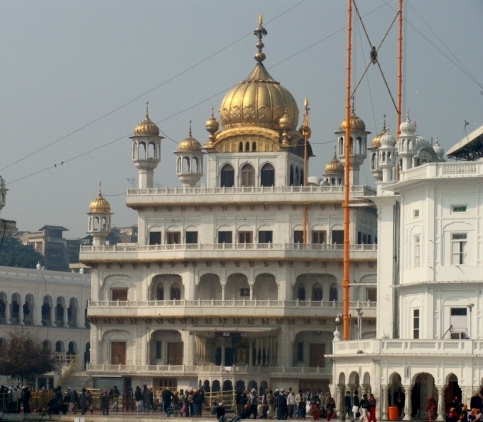
The Vadda Ghallughara (Great Holocaust) took place on 27 Magh, 1762 CE, during the sixth invasion of Ahmad Shah Abdali. Abdali carried out a total of 11 invasions of India. Ultimately, it was only after suffering repeated humiliating defeats at the hands of the Sikhs that he stopped invading. In 1761, after defeating the Marathas during his fifth invasion, Abdali captured around 25–26 thousand Maratha and Hindu women and children and began his journey back to Kabul. As soon as he entered Punjab, the Sikhs, as always, followed him. They looted wealth worth lakhs of rupees and rescued thousands of Hindu girls and boys from Abdali’s captivity, safely escorting them back to their homes. By then, Abdali had broken the power of both the Mughals and the Marathas in India. The Sikhs were the only force left to challenge him. As soon as Abdali returned to Kabul, the Sikhs took control of various regions. In October 1761, the Sikhs passed a Gurmata and, under the leadership of Nawab Kapur Singh, defeated Ubaid Khan, the governor of Lahore, and captured the city. Nawab Kapur Singh installed Sardar Jassa Singh Ahluwalia on the throne and bestowed upon him the title “Sultan-ul-Qaum.” The Sikhs knew they did not yet have the strength to retain permanent control over Lahore. Therefore, they withdrew and laid siege to the informer Mahant Aqil Das Niranjania of Jandiala Sarkari, who had earlier betrayed and caused the execution of warriors such as Bhai Taru Singh and Mehtab Singh Mirankotia. The Mahant sent messengers to Abdali, who was already marching towards Punjab. The Sikhs, upon learning of Abdali’s advance, sent their families toward the sandy regions of Malwa so they could confront Abdali without concern. When Abdali reached Lahore, the Sikhs had crossed the Sutlej River and camped near the village of Kup, close to Malerkotla. The Sikh force numbered around 50,000, accompanied by nearly 50–60 thousand women, children, and elderly people. Acting on Abdali’s orders, Nawab Bhikhan Shah of Malerkotla and Zain Khan, the governor of Sirhind, had surrounded the Sikhs. On 27 Magh, 1762, before sunrise, Abdali launched a brutal attack on the Dal Khalsa. He divided his army in two—keeping one half with himself and sending the other half under his vizier Shah Wali Khan, along with Zain Khan, Bhikhan Khan, and Diwan Lakhmi Narayan, to attack the Sikh caravan. The Sikhs encircled their caravan from all sides and stood firm in battle. Leaders of almost all Sikh misls participated under the command of Sardar Jassa Singh Ahluwalia. Shah Wali Khan inflicted severe damage—thousands of elderly people, women, and children were killed, and thousands were taken captive. Upon learning this, Sardar Jassa Singh dispatched Sardar Sham Singh, Sardar Karora Singh, Sardar Nahar Singh, and Sardar Karam Singh for assistance. The Sikhs rescued the captives and inflicted heavy losses on Shah Wali’s forces. General Sar Buland Khan was wounded by Sardar Charhat Singh, and the chief commander Jahan Khan was wounded by Sardar Jassa Singh himself. In this Ghallughara, the Sikh force numbered about 50,000, while Abdali’s army numbered around 200,000. Approximately 16–18 thousand Sikh women and children and 10–12 thousand Sikh warriors—about 25–30 thousand in total—were martyred. Around 10–12 thousand soldiers of Abdali’s army were also killed. All Sikh belongings were looted. Abdali’s army included forces of all local faujdars and chaudhries of Punjab. Abdali pursued the Sikhs up to Barnala and collected their scattered bodies, loading them onto 60 carts and hanging them from the towers of Lahore’s gates. This battle is remembered for the unparalleled bravery of the Sikhs. The ancient birs (manuscripts) of Amritsar and Damdama Sahib were also destroyed by Abdali. In memory of the Sikhs martyred in this Ghallughara, a memorial stands at Kup-Rahira. This event remains a glorious chapter in Sikh history and is remembered as the Vadda Ghallughara.
Please log in to comment.