

Martyrdom Day of Bhai Sahib Bhai Maharaj Singh Ji of Naurangabad
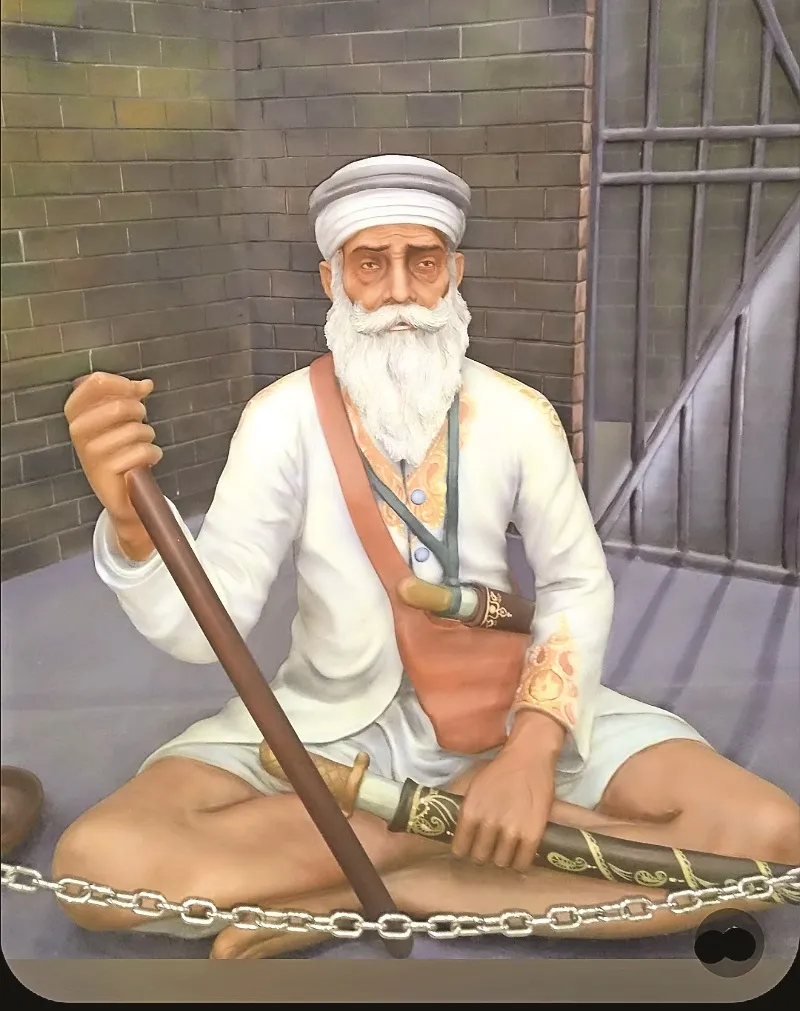
July 5 marks the martyrdom day of Bhai Sahib Bhai Maharaj Singh Ji of Naurangabad. Let us take a brief look at the life of Bhai Sahib Ji.
The Sikh nation has the honor of having made 85% of the sacrifices in the country’s freedom struggle, while Sikhs make up only around 2% of India’s population. To drive out the Mughals, the Guru Sahiban and countless Singhs sacrificed themselves for the protection of this country and Punjab. The honor of beginning the first struggle to drive the British out of the country goes to Shaheed Bhai Maharaj Singh of Naurangabad. He was the pioneer of the first struggle against the British and the first movement to fight the British after the Anglo-Sikh war.
He was born on January 13, 1780, on the day of Lohri, in the village of Rabbon Neechi, district Jalandhar, in united Punjab. He was named Nihal Singh. His childhood was spent in the dera of Nirmala saints, which is why from the very beginning his nature was saintly. When he grew a little older and heard about the greatness of Baba Bir Singh Ji of Naurangabad, he also came to his dera and began doing seva in the langar hall. He served the arriving sangat with love and devotion, and while serving food and water, he would say, “Take this, Maharaj Ji; take this, Maharaj Ji.” In this way, his name became famous as Maharaj Singh.
After the martyrdom of Baba Bir Singh Ji, the sangat appointed him as the head of the Naurangabad dera. When difficult times came upon the Sikhs, he handed over the seat to his disciple Bhai Vir Singh, left Naurangabad, and came to Amritsar. There he made Sandhu Ka Talab his headquarters and started activities to save Punjab and the Sikhs. He began visiting villages and gathered people who agreed with his thinking and were against British rule, whether they were Hindus, Muslims, Sikhs, or belonged to any other faith.
By that time, he had grown quite old. Sikh rule had come to an end, and he had made tireless efforts to save it, but because of the betrayals of traitors, he could not succeed. In the battles of Ramnagar and Chillianwala, he firmly supported the Sikh forces in every possible way. Many great personalities were also with him in this effort, including Bikram Singh Bedi, Sher Singh, Rachhpal Singh, and others.
For about a year, Maharaja Duleep Singh had been under detention in the Lahore Fort. A Prema Plot was planned to take Maharaja Duleep Singh out of the fort and move him to another place for his protection. This plot was also connected with a plan to kill British Resident Henry Lawrence in Lahore, along with the courtiers and officials who had joined hands with the British government. Maharani Jinda, who was under British captivity at that time, came to know about this and contacted them. The Maharani was eagerly waiting for a chance to meet her separated son and to regain his lost kingdom. Maharani Jinda also spoke with Mul Raj.
Bhai Maharaj Singh Ji also went with his 400 armed soldiers to meet Mul Raj. When he reached Jhang, he was warmly welcomed. Sangats came from far and wide to meet Bhai Maharaj Singh, the head of the dera. After crossing the Chenab River, when he met Mul Raj and held discussions with him, differences arose between them. He understood that Mul Raj was thinking only about his own Multan and had no concern for Punjab. But Bhai Maharaj Singh Ji’s vision was much broader — to save Punjab and Punjabi identity and to restore the rule of the Sikh nation. From there, he quietly took leave of Mul Chand and separated himself.
When the British came to know that Maharaj Singh was the main person behind the Prema Plot, he was ordered to appear before the Regency Council, but Maharaj Singh refused to appear. The British banned him from going outside Naurangabad and confiscated his property. This incident marked the beginning of Maharaj Singh’s revolutionary journey.
He went underground and began supporting those who were rebelling against the British. In 1849, when the Sikh forces were preparing to surrender in Gujarat, he reached Gujarat at that very time and opposed the surrender through a powerful speech. He wanted to fight one more battle against the British, but because many leaders supported the traitors, the decision was made to lay down arms. The army had to surrender its weapons with great reluctance, sorrow, and tears in their eyes. At that time, his words were, “Today, Ranjit Singh has died.” In his view, that day was the true death of the Maharaja.
After the end of Sikh rule, he continued his rebellion against the British on his own and made a secret hideout in the fields of Jasowal village near Dev Batala, close to Jammu. Bhai Maharaj Singh fixed January 3, 1850, as the day to rebel against the British and create an uprising. According to this plan, the revolt was to begin from the cantonments of Jalandhar and Hoshiarpur. The preparations were complete. To fight any war, three things are needed — an army, weapons, and money. The soldiers were coming on their own after seeing his passion for the Sikh nation. For weapons and money, British treasuries and cantonments were to be raided.
Six days earlier, on December 28, 1849, a spy informed the Deputy Commissioner of Jalandhar and got Baba Maharaj Singh arrested from the thicket of Adampur. The British kept him in Jalandhar jail for a few days, where crowds of sangat came every day to bow before him, bowing to the walls of the jail and returning. Fearing that a rebellion might break out, the British first kept him imprisoned for some time in Fort William in Calcutta and then sent him to Harbour Point, Singapore.
He was kept in such a dark prison cell that its two windows were sealed with bricks and mortar. There was no trace of light at all. In extremely poor conditions and suffering great hardships, he spent 6 years in that dark cell with the support of Naam Simran. There, he lost his eyesight and became a victim of a terrible disease like cancer. He was cut off from his mission, cut off from his country and his land, and cut off from the air and water of his homeland. Even after suffering so much, he did not accept British submission. Finally, on July 5, 1856, he attained martyrdom in the prison of Singapore. British historian Arnold wrote, “If Bhai Maharaj Singh had not been captured on December 28, Punjab would have slipped out of our hands.”
Memorial Built in Singapore
In memory of Bhai Maharaj Singh, who attained martyrdom in the Singapore prison, a gurdwara has been built on Silat Road in Singapore. Alongside the gurdwara, there is a memorial dedicated to Shaheed Bhai Maharaj Singh. At this place, besides Punjabis, people from other communities — Chinese, Tamil, Sri Lankan, Madrasi, and Malaysian people — also bow in respect. This place is under the Central Sikh Gurdwara Board, where a library, a Gurmat music academy, and an academy for the preaching of Sikhi are being run in Baba Ji’s memory. The foundation stone of the development project at the Silat Road Gurdwara was laid on April 13, 1992, by the then Minister for Law and Home Affairs, Professor Jayakumar.
In memory of Shaheed Maharaj Singh, Tap Asthan Gurdwara Sri Damdama Sahib has been built in his ancestral village Rabbo, along with a memorial to Baba Kharak Singh, who remained with him until the end. Every year, his birth anniversary is observed there on January 13, and his martyrdom day is observed on July 5.
Zorawar Singh Tarsikka
Waheguru Ji Ka Khalsa, Waheguru Ji Ki Fateh.
Join the conversation
Sign in to comment or join the discussion.

Loading comments…