

Maharani Jind Kaur
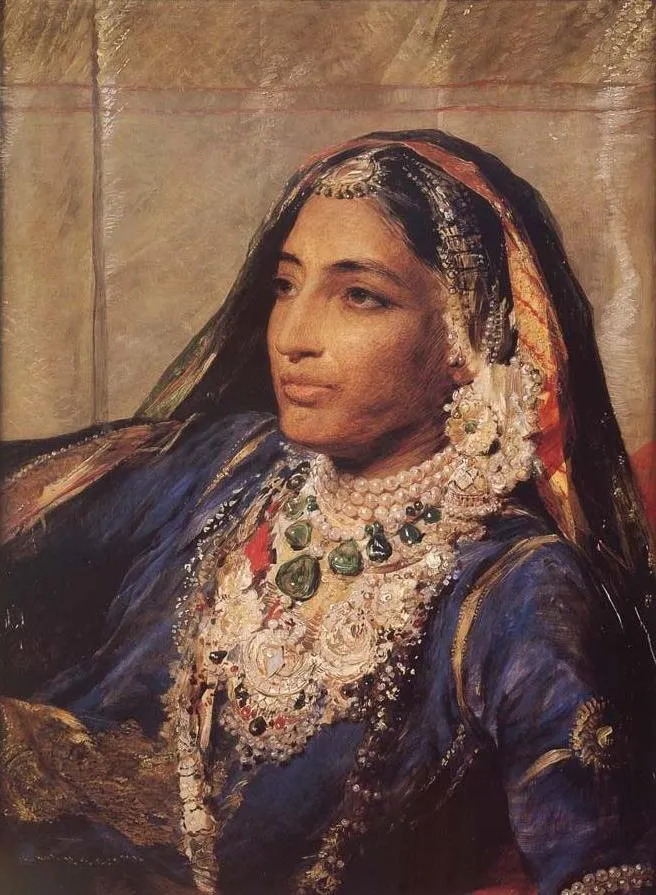
19 August 1847
When Maharaja Duleep Singh refused, before the full royal assembly, to place the ceremonial tilak of the title of “Raja” upon Misr Teja Singh, the British Resident, Henry Lawrence, was left grinding his teeth in anger. He held Maharani Jind Kaur responsible for the entire incident.
Maharani Jind Kaur knew that the British were granting Misr Teja Singh the title of Raja as a reward for his betrayal of the country of Punjab. She could not, therefore, permit her son to place a tilak upon the forehead of the traitor who had betrayed his kingdom.
Henry Lawrence portrayed Maharaja Duleep Singh’s refusal as an insult to the British Government. Abusing the authority at his disposal, disregarding every moral consideration and openly displaying his high-handedness, he immediately had Maharani Jind Kaur imprisoned in Samman Burj.
From Samman Burj, Maharani Jind Kaur wrote a letter to Henry Lawrence. The final paragraph of that letter is particularly significant:
“The things you are doing to us have not been done in any princely state. Why do you seize the kingdom in secrecy? Why do you not do it openly? On the one hand, you speak the language of friendship, while on the other, you imprison us. Give me justice, or I shall appeal in London. Keep those three or four ungrateful traitors with you, and on their advice have the rest of Punjab put to death.”
In this correspondence, Maharani Jind Kaur questioned the intentions of the British Resident. She declared that imprisoning her and publicly dishonouring her, without conducting an investigation, presenting any written evidence or proving any accusation against her, was an act of extreme injustice and oppression.
The Maharani demanded an open investigation. She also stated that the pension due to her under the Treaty of Bhairowal was not being paid. Consequently, she was being forced to sell her jewellery in order to meet her expenses.
She was being harassed to such an extent that even obtaining basic food and water had become difficult for her.
It is a historical reality that the British did not even honour the friendship they had claimed with their deceased friend. They betrayed their friend and mistreated his family.
At the same time, the Maharani also feared for the life of her son, Maharaja Duleep Singh. In her letter, she described how the young Maharaja was being frightened and intimidated because he was merely a child.
The Maharani also taunted the British Resident, telling him that if the British intended to seize Punjab, they should remove the mask of deception and come forward openly. Why were they playing such deceitful games?
This letter from the Maharani further enraged Henry Lawrence. He was unwilling to tolerate even the Maharani’s continued imprisonment within Lahore Fort.
The people’s love and respect for the Maharani, her political wisdom, her courage in expressing herself and, above all, her deep love for the country of Punjab frightened the British authorities.
Henry Lawrence and the British Government believed that for as long as the Maharani remained in Lahore, she would continue to pose a threat to British ambitions. They feared that they would never succeed in carrying out their plans while she remained there.
The British began searching for an excuse to remove her from Lahore. Eventually, a false accusation was made against the Maharani, alleging that she had known about a conspiracy to assassinate the traitor Teja Singh.
Since there was no evidence, the Governor-General did not consider it appropriate to take any other severe action against her. However, under the pretext of political necessity, he ordered that the Maharani be removed from Lahore and imprisoned elsewhere.
On the morning of 19 August 1847, Maharaja Duleep Singh was taken from the royal palace inside Lahore Fort and sent to Shalimar Garden.
That same night, between approximately eight and nine o’clock, Maharani Jind Kaur was taken under military guard from Lahore to the fort at Sheikhupura. She arrived there in the early hours of 20 August.
On 19 August, the oppressive British authorities began the long and painful story of the separation of a mother from her son.
In their efforts to bring all the princely states of Hindustan under their control, the British Government had perhaps committed no greater injustice than the one it inflicted upon the family of its deceased friend in the country of Punjab.
For this, they can never be forgiven.
Join the conversation
Sign in to comment or join the discussion.




Loading comments…