

The Battle of Saragarhi
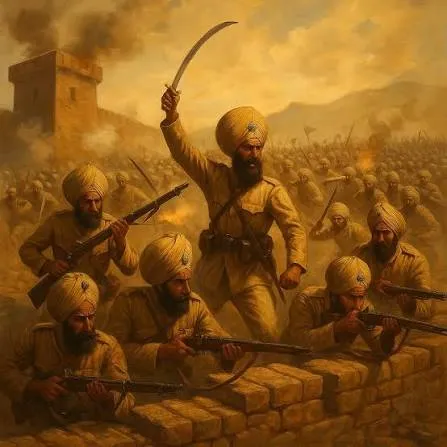
The Battle of Saragarhi was fought on 12 September 1897 at Saragarhi on the North-West Frontier, close to the borderlands of Afghanistan.
The battle was fought between 21 soldiers of the British Indian Army's **36th Sikh Regiment**, later associated with the modern 4 Sikh Regiment, and a vastly larger force of Afridi and other tribal Pathan fighters.
The extraordinary resistance of these 21 Sikh soldiers made Saragarhi one of the most remembered episodes of courage in Indian military history.
## Historical Background
Saragarhi was a small settlement located at an elevation of around 6,000 feet above sea level.
The surrounding mountainous region lay along the frontier separating British-controlled territory from Afghanistan.
Saragarhi was situated in the Samana Range in the Kohat region. Kohat was roughly 35 miles away, while Peshawar was approximately 50 miles away.
The post was strategically important because it stood between **Fort Lockhart** and **Fort Gulistan**, which were separated by approximately six kilometres.
Because the rugged landscape prevented the two forts from having a clear direct line of communication, the Saragarhi post was established as a signalling station between them.
## Why the Region Was Important to the British
Following the period of Maharaja Ranjit Singh's rule, the British gradually brought the region under their control during the latter part of the nineteenth century.
However, many of the fiercely independent Pathan and tribal communities resisted British authority, and in 1896 opposition to British control intensified.
The region was also important for trade.
Tribal groups frequently attacked traders and smaller British military detachments whenever an opportunity arose.
The route through the Kurram Valley, which was important for trade with Kabul, consequently became increasingly dangerous.
The British had already maintained positions on the heights of the Samana Range for several years.
On 31 December 1896, a Sikh battalion arriving at Kohat was ordered to strengthen British control over the upper Samana region.
The battalion was divided into two wings.
The right wing was placed under Lieutenant Colonel Haughton, who occupied Fort Lockhart on 2 January 1897.
Detachments from the regiment were deployed at several vulnerable locations around the fort, including Saragarhi, Dar, Sangar, Sartop, Kurag and Gulistan.
On 8 January, the left wing, commanded by Captain W. V. Gordon, occupied the Parachinar area.
Posts at Thal and Sadda were also placed under the left wing.
A reserve force was additionally maintained so that reinforcements could be deployed when required.
## Tribal Attacks
Between 27 August and 8 September 1897, Orakzai tribesmen launched intense attacks against positions connected with the left wing.
The attacks were repulsed, and by 10 September the tribal forces had been pushed back toward the Khanki Valley.
Four attacks by a force said to number around 10,000 tribesmen against the Samana positions were also defeated.
Afterward, Afridi leaders reportedly decided to concentrate their attack on Saragarhi because only 21 soldiers were stationed there.
On 12 September, a large tribal force surrounded the Saragarhi post and launched a major assault.
The attack effectively cut the isolated post off from the outside world.
Command of Saragarhi was held by **Havildar Ishar Singh Gill**, associated with the village of Jhorran in Ludhiana district.
According to the account, the attackers offered Ishar Singh incentives to abandon the post, including safe passage and rewards.
He refused.
Lieutenant Colonel Haughton could observe developments from Fort Lockhart and attempted to send reinforcements, but the surrounding area had already been occupied by the attacking force and relief efforts failed.
## Signalman Gurmukh Singh
The battle began at approximately 9:30 in the morning and continued for many hours.
After around six hours of fighting, hundreds of attackers had reportedly been killed, while 12 Sikh soldiers inside the post had also fallen.
Ammunition was running dangerously low, but the defenders continued fighting.
Eventually, the attackers managed to create a breach in one section of the wall.
The Sikh soldiers still resisted attempts to enter the post.
The attackers then reportedly set fire to grass and vegetation around the position, creating heavy smoke and reducing visibility.
As the ammunition ran out and the fighting moved into close quarters, the defenders fought with their bayonets.
One after another, 20 soldiers were killed.
Eventually only **Signalman Gurmukh Singh** remained.
Gurmukh Singh sent a final signal to Fort Lockhart stating that all his comrades had fallen and that he was the only man left.
He requested permission to close the signalling station so that he too could join the battle.
After sending his final message, he shut down the signalling equipment, raised a Sikh battle cry and entered the fight.
According to the traditional account, he killed more than 20 attackers in close combat with his rifle and bayonet.
Eventually the attackers set fire to the post.
Thus ended one of the most remarkable stories of resistance and battlefield courage associated with the Sikh soldiers of the British Indian Army.
The attackers themselves were said to have been astonished that such a small number of defenders had resisted such a large force for so long.
## Honouring the Fallen
When news of the Battle of Saragarhi reached London, members of both Houses of the British Parliament reportedly stood in tribute to the fallen soldiers.
Reports of the battle were published around the world, bringing international attention to the courage displayed by the Sikh troops.
Queen Victoria was also said to have been deeply impressed by their actions.
All 21 defenders were posthumously awarded the **Indian Order of Merit**, one of the highest gallantry decorations then available to Indian soldiers serving under British rule.
The families of the fallen soldiers were also reportedly granted land and financial assistance, including 500 rupees for each soldier's family—a substantial amount at the time.
The Indian Order of Merit was among the most prestigious military decorations available to Indian troops during this period.
The collective recognition of all 21 men made the Battle of Saragarhi an exceptional episode in military history.
## The Saragarhi Memorial
A memorial was later constructed to honour the men who defended Saragarhi.
The inscription commemorates the non-commissioned officers and soldiers of the 36th Sikh Regiment of the Bengal Infantry whose names were engraved there and who died while defending Saragarhi on 12 September 1897.
The memorial continues to preserve the memory of their sacrifice.
## Saragarhi in Education and Public Memory
The Battle of Saragarhi is remembered in many parts of the world as an extraordinary example of courage, discipline and resistance against overwhelming odds.
It has also been claimed that the story has been taught in schools in France and that the battle has been recognised among the world's notable battles.
Saragarhi Day is commemorated on a significant scale in countries including the United Kingdom and Canada.
Government representatives, descendants of the soldiers and Sikh military veterans often participate in ceremonies honouring the fallen.
## The 21 Martyrs of Saragarhi
The names associated with the Sikh soldiers who gave their lives defending Saragarhi include:
1. Havildar Ishar Singh Gill — Jhorran village, Ludhiana district — Commander
2. Naik Lal Singh
3. Lance Naik Chanda Singh
4. Sepoy Sundar Singh
5. Sepoy Uttam Singh
6. Sepoy Hira Singh
7. Sepoy Ram Singh
8. Sepoy Jiwa Singh
9. Sepoy Jiwan Singh
10. Sepoy Gurmukh Singh — Signalman
11. Sepoy Bhola Singh
12. Sepoy Bela Singh
13. Sepoy Nand Singh
14. Sepoy Sahib Singh
15. Sepoy Daya Singh
16. Sepoy Bhagwan Singh
17. Sepoy Narain Singh
18. Sepoy Gurmukh Singh
19. Sepoy Sindar Singh
Together, **21 soldiers of the 36th Sikh Regiment** made the ultimate sacrifice while defending Saragarhi.
Their courage, discipline and determination to remain at their post until the very end continue to make the Battle of Saragarhi one of the most celebrated stories of Sikh military bravery.
**Countless salutations to the immortal martyrs of Saragarhi.**
Join the conversation
Sign in to comment or join the discussion.

Loading comments…