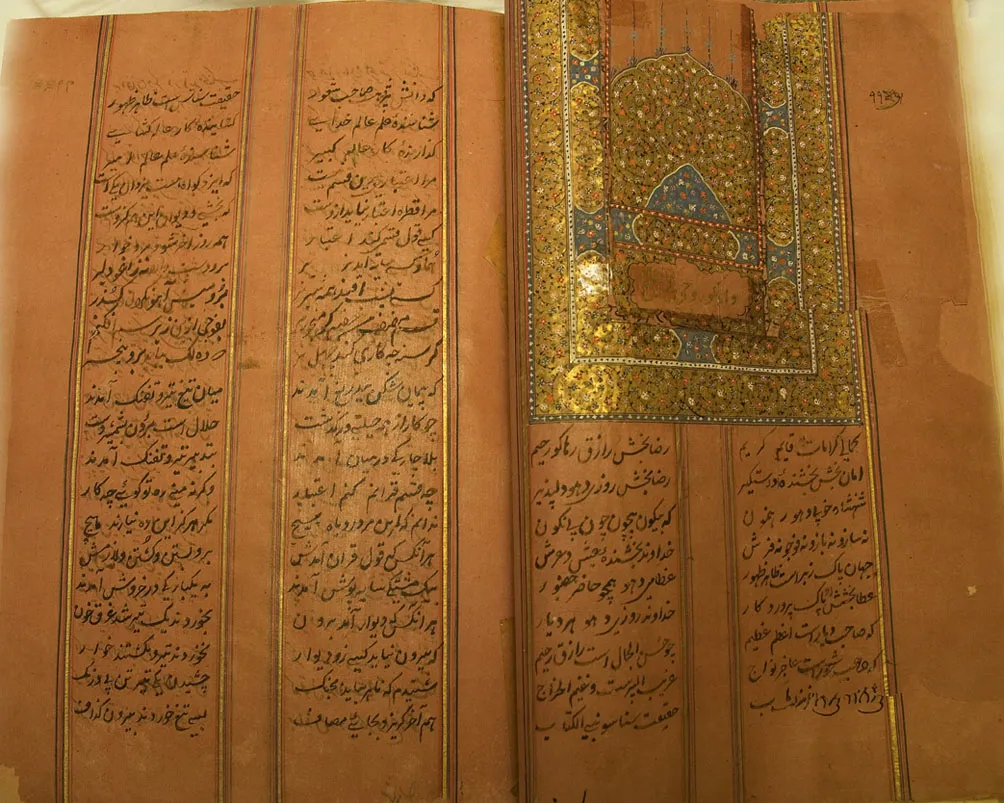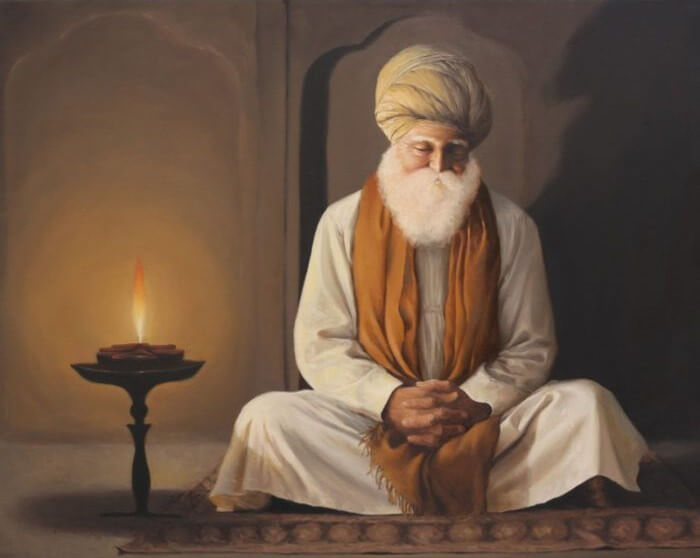
Shaheed Bibi Ranjit Kaur was a great Sikh heroine, almost revered like a goddess among the Sikhs. To uphold her faith, she endured severe hardships, repeatedly confronted tyrants, and with her bravery, agility, and wisdom, she managed many times to escape from the clutches of cruel enemies. In the end, however, she fell into the hands of Pathans and was taken to Kabul. From the palace of the king in Kabul, she later managed to take along the royal consort Hamida Begum, and together with her fiancé Daljeet Singh, they set off toward Punjab. During that journey, she killed many soldiers in battle and finally attained martyrdom herself. After her martyrdom, Daljeet Singh, in loyalty to her pure and lofty love, never married again. Instead, he continued to struggle for the freedom of the land. Later he served in the army of Maharaja Ranjit Singh. When the Sikh kingdom was destroyed through the conspiracies of traitors, he renounced worldly life, retired to the forests near Haridwar, spent his time in remembrance of the Almighty, and around 1911 CE, passed away at about 125 years of age. Around 1787 CE, a daughter was born to Sardar Pratap Singh. He named her Ranjit Kaur — “the one who gains victory in battle” — because at that time the Sikhs were fighting against Muslim rulers for the freedom of the country. As the home environment was deeply religious, this little girl, at a young age, learned Gurmukhi, memorized Japji Sahib and other prayers. She was as beautiful in appearance as she was sweet in voice. Reciting Gurbani in a melodious tune, she would captivate everyone. She served in the dharamsala, took part in the service of the congregation, and cooled hearts with her gentle recitation. Her father also taught her martial arts (shastar-vidya), particularly the use of the dagger (katar). By the time she was about ten, she was engaged to Daljeet Singh, a thirteen-year-old boy, son of Sardar Jagjeet Singh from a nearby village. At that time, in Delhi, the Marathas were causing great trouble to the Mughal emperor Shah Alam. They plundered Delhi and oppressed the Muslims. The nobles and ministers, unable to cope, decided to seek help from the Sikhs and sent word to Sardar Baghel Singh. Baghel Singh agreed to help drive the Marathas out of Delhi, but in return he made the emperor sign an agreement giving the Sikhs full permission to build gurdwaras in Delhi in memory of the Sikh Gurus. Baghel Singh sent a message to the Sikhs in Punjab to assemble and march toward Delhi. The Marathas, afraid of the Sikhs, fled Delhi and returned to their regions. But once the Marathas had left and the Sikhs arrived, the rulers reneged on their written promise and prepared to fight the Sikhs instead. At Ajmeri Gate, the Sikhs were stopped, and a fierce battle broke out. The Sikhs fought with great courage, pushed the Mughal forces back, and Delhi was plundered. After gathering substantial wealth, the Sikhs camped at Majnu ka Tilla — a place sanctified by the footsteps of Guru Nanak Dev Ji and Guru Hargobind Sahib Ji. There they prepared karah prasad and ate to their fill. When Shah Alam learned that Delhi had been looted due to the deceit and poor judgment of his own nobles and ministers, he felt deep remorse. He sent his representative to humbly ask forgiveness and invited Sardar Baghel Singh to meet him. Soon, Sardar Baghel Singh rode into the city on an elephant, accompanied by five hundred horsemen in full Khalsa attire, and with them were Sikh women (bibian) dressed bravely and modestly like Singhs. They passed in a majestic procession through the city and entered the fort. The emperor welcomed them with great respect and showed the women the palaces of the queens and royal ladies. Among these women was Bibi Ranjit Kaur — whose beauty and youth outshone all the queens. From within the palace, Prince Ali Gauhar caught sight of her and became infatuated. The emperor then fulfilled his written promise and allowed Baghel Singh to build gurdwaras in Delhi. Baghel Singh kept five hundred Singhs with him and sent the remaining Sikhs back to Punjab. In Chandni Chowk, at the place of the martyrdom and cremation of the Ninth Guru, mosques were demolished and a gurdwara was built. Similarly, Gurdwara Bangla Sahib was built at the place where the Eighth Guru had stayed and where his cremation took place. At the site from where Guru Gobind Singh Ji shot an arrow that struck the leg of Bahadur Shah’s bed, and at Majnu ka Tilla, and several other holy spots, gurdwaras were established. During this time, sitting as a kotwal (chief magistrate) of Delhi, Sardar Baghel Singh decided many complex cases with complete justice. Every oppressed person who came to him would find relief. He would reconcile both parties and send them away satisfied. Once a week, officers along with Baghel Singh would tour the city; people came to love them deeply. Meanwhile, Ranjit Kaur’s father, Sardar Pratap Singh, was martyred while fighting against the Turks. After his death, Ranjit Kaur and her mother started living with Sikh jathas in the forests. One day, Ranjit Kaur went to fetch water in the jungle with some other women. She wandered farther than them and did not return. Everyone, especially her mother, became extremely worried. Ranjit Kaur was the embodiment of service, sweet speech, wisdom, and beauty. Because of her learning and noble qualities, she was regarded in her group almost as a goddess. All Sikhs considered her truly blessed, and her mother fortunate to have such a daughter. Other Sikh women even felt envy and wished they had such a child. After some time, all the Sikh women formed search parties and went far and wide looking for her. After much searching, an old woman told them she had seen four soldiers carrying a fainting young woman in a palanquin, accompanied by a horseman. Everyone realized that Ranjit Kaur had been abducted. Her in-laws heard the news as well. Her fiancé, Daljeet Singh, an eighteen-year-old youth just entering manhood, secretly armed himself and left in the night to search for her without informing his parents. On the other side, Prince Ali Gauhar had Ranjit Kaur placed in a closed palanquin, taken into the palace basements, and imprisoned there. He kept her hungry and tried to force her to accept nikah with him. He said: “You are now a prisoner. No one can free you. Instead of starving, marry me. I will make you the chief queen.” Hearing talk of nikah, Ranjit Kaur flared up in righteous anger. She immediately drew a dagger hidden beneath her kurta and attacked. The prince quickly stepped aside and struck at her with his sword. She ducked; the sword swung over her, and in that instant she thrust the dagger deep into his chest. Though he was courageous, this blow made him scream loudly and fall unconscious. His cry echoed through the cellar. Soldiers rushed down, lifted him up, and carried him out, with blood pouring from the wound. After the prince was wounded, the emperor summoned both Ranjit Kaur and the prince to court. He heard their statements. Ranjit Kaur explained how she had been abducted by force and pressed to accept nikah against her will: “Sikh women cannot abandon their faith. We may be destroyed, but we will not give up our dharma. To protect my honor and my religion, I struck this blow.” Ignoring the demands of the qazi, the emperor ordered that Ranjit Kaur be escorted safely to a jungle area and left near the Sikh jathas. But as she was being taken away, fate took another turn. She fell into the hands of Suleiman, a notorious dacoit who had amassed immense wealth and weapons. He had her imprisoned in an underground cell where there was a well known as the “Well of Hell.” He used to show this well to young women, intimidate them by claiming many bodies lay rotting within, and then strip them of honor and wealth. He took Ranjit Kaur to this well and said: “Look! This is the well of hell. Many girls like you have their corpses lying here. If you refuse to marry me, your honor will be destroyed and you will be thrown in here as well.” While he was still threatening her, the lioness-like Ranjit Kaur, taking the Name of Guru on her lips, gave him a mighty shove and he fell headlong into the well, ending his evil forever. Fearless, she tied up one of the Muslim guards and knocked on the large gate. When Suleiman’s men opened it, she told them everything that had happened. They were greatly pleased to hear of the tyrant’s end. They then freed Daljeet Singh, who had been imprisoned in another cell. Taking Suleiman’s keys, they looted the treasure and weapons stored in the underground chambers, loaded them on their horses, and left for their homes. In the same way, the share of wealth and weapons given to Daljeet Singh and Ranjit Kaur was also loaded on Suleiman’s horses, and they all left for the Sikh encampments. Travelling by night and resting by day, they reached the Sikhs near Delhi in about two days. Seeing Ranjit Kaur alive and the horses loaded with wealth, joy swept through the camp. Her mother received many congratulations. When the Singhs heard from Ranjit Kaur about the misconduct of the prince, they were enraged and surrounded the emperor in his fort. The emperor wrote a formal apology, begged forgiveness for his son’s actions, and gave five hundred rupees for karah prasad. During this time, Ranjit Kaur’s mother came under the banner of Sardar Dayal Singh of the Shaheedi Misl, and began serving in the langar. Ranjit Kaur helped her mother and also gathered the Sikh women, teaching them to remain firm in their religion. She would tell them: “One who walks on the path of Sikhi and trusts the Guru — not a single hair of that person can be harmed. The Lord Himself becomes their protector and helper, just as He has done for me.” Her sweet words and teachings deeply moved the listeners. All began to love and respect her as if she were a living goddess. Meanwhile, the parents of Daljeet Singh were eager to bring such a wise and noble daughter-in-law home as soon as possible. A wedding date was fixed, and the barat of Daljeet Singh arrived. There was great hospitality that night. In the morning, Ranjit Kaur went with her companions to the forest to fetch water. There, three Pathans on horseback encountered her. One rode ahead and tried to grab her, but Ranjit Kaur immediately drew her dagger and thrust it into his belly, killing him on the spot. The remaining two seized her, tied her mouth so she could not cry out, and carried her away on horseback. She was taken to the king of Kabul. Seeing her face and beauty, the king was captivated and took her into his palace, making her a personal attendant of his chief wife, Hamida Bano. In this way, she stayed there for about six months. The king was often away on campaigns. Hamida Bano grew very fond of her. Through Ranjit Kaur’s words, manner, and recitation of Gurbani, Hamida slowly became imbued with a spiritual and devotional mood. Though Ranjit had been kept as a maid, her noble and sweet nature was such that the palace maids began to serve her almost like another queen. She remained absorbed in simran. During her daily prayers, Hamida would come and sit close, and slowly she too developed a taste for Gurbani. Ranjit Kaur prepared her own food separately. About a year later, while the king was still away, Hamida had already memorized much Gurbani and, hearing the stories of the bravery of the Gurus and the Sikhs, developed a strong desire to go to Punjab with Ranjit Kaur. In the king’s absence, one night, the same minister who had first seen Ranjit Kaur and become obsessed with her beauty, came into the palace drunk. The maids were terrified. Hearing noise, Hamida cried out. Ranjit Kaur calmed her and then, like a lioness, seized the minister by the neck and strangled him so hard that his eyes bulged and he fell senseless to the ground. Some precious papers fell out of his pocket. As she picked up his sword and was about to strike him down, he clutched her feet and said: “You are like my daughter — spare me!” He then paid her a thousand rupees and received his important papers back. Out of this money, she sent two messengers with five hundred rupees and a letter addressed to the Singhs and to Daljeet Singh, asking that he come as soon as possible to take her away. The messengers eventually reached Daljeet Singh with the letter. Reading it, he at once armed himself fully, took some money, mounted his horse, and set out. Passing through Pathan territories, he reached Peshawar, adopted the dress of a Pathan, and then proceeded to Kabul, where he stayed at the house of an old woman named Maksudan. Spending considerable money, one night he bribed a palace guard with wine and won his favor. Then, under the cover of darkness, Hamida Bano and Ranjit Kaur both mounted horses and escaped with Daljeet Singh. By the next morning, news had spread through the city that the two women had disappeared from the palace, and it became known that a young man from Punjab had carried out this act. The same minister ordered soldiers to pursue them in all directions. In haste, fifteen to twenty horsemen, many of them without proper arms, rode out to chase them. They caught up and tried to surround them. Ranjit Kaur and Daljeet Singh killed many of the pursuing Pathans. Those who escaped returned and called for more reinforcements, and soon hundreds of Pathans were on their trail. Fighting fearlessly, Ranjit Kaur struck down many Pathans. Finally, a Pathan’s spear struck her in the side, and she fell there as a martyr. Daljeet Singh barely managed to escape from the Pathans, but Hamida Bano was recaptured and taken back. Thus, that lioness-like Bibi Ranjit Kaur, who many times, through her courage and wisdom, had slipped out of the clutches of enemies while upholding the honor of the Sikh faith, was martyred after sending many Pathans to their doom. Daljeet Singh, as a testimony of his true and pure love for her, never married any other woman for the rest of his youth. Instead, he joined the army of Maharaja Ranjit Singh, fighting to break the chains of slavery of the land, and there too he displayed great courage. When the Sikh kingdom fell, he took renunciation, went to the region near Haridwar, and lived there as a saint. Having spent his life in remembrance of the Divine, he passed away at the age of about 125 years. – Joravar Singh Tarsikka
Please log in to comment.