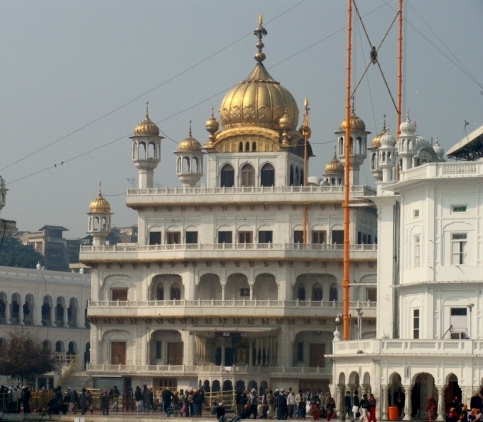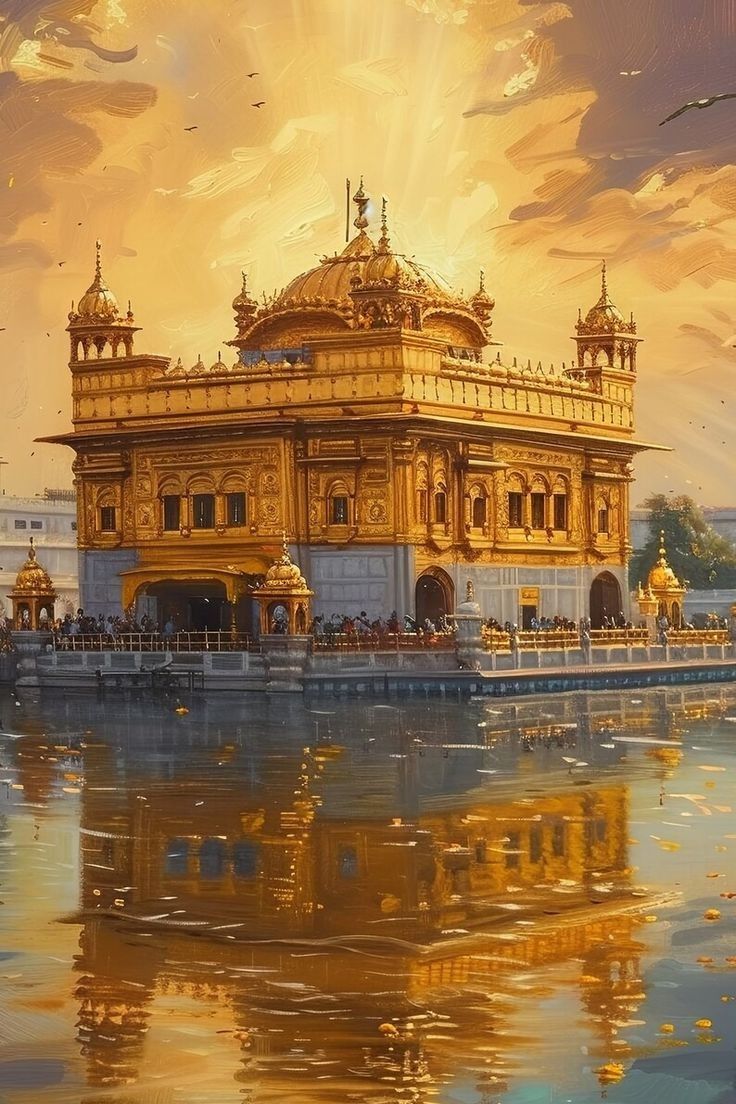
The land of Punjab is regarded as the birthplace of great warriors. In the history of Punjab, we find countless such heroes whose tales of bravery are still famous today. In the 17th century, on this sacred soil of Punjab, there was born such a legendary figure—Baba Deep Singh Ji. He is remembered as the only warrior in history who, even after being beheaded on the battlefield, continued to fight with his severed head in his hand. During battle, Baba Deep Singh Ji struck such terror into the Mughal forces with his courage and fearlessness that they were forced to kneel. The very name of Baba Deep Singh made the enemy tremble. Let us learn about the story of this great Sikh warrior. Background of his birth This story goes back to the 17th century. A farmer named Bhai Bhagtū (Bhagtu) lived with his family in the village Pahuwind, in the Amritsar area. By God’s grace, there was no shortage of material comforts in his home, except for the absence of a child. Bhai Bhagtu and his wife Gioṇī Ji (Jioṇī Ji) constantly prayed before the Almighty that their lives, too, be blessed with the joy of a child. One day, they met a saintly Mahatma, who told them that a greatly gifted child would be born in their household and that they should name him “Deep”. Birth of Baba Deep Singh Ji At last, the Lord accepted their heartfelt prayers. On 26 January 1682, a son was born to them, and he was named Deep Singh. Being the only child, his parents raised him with utmost love and affection. When Deep Singh Ji turned 12 years old, his parents took him to Sri Anandpur Sahib, where for the very first time, he met the Tenth Guru of the Sikhs, Sri Guru Gobind Singh Ji. He stayed there for some time with his parents and began serving in the Guru’s court. After a few days, when the family was preparing to return to their village, Guru Gobind Singh Ji requested Deep Singh’s parents to leave him there in the Guru’s service. How could they refuse the Guru’s wish? They gladly agreed, and Deep Singh Ji remained at Anandpur Sahib with the Guru. There, under Guru Sahib’s guidance, Deep Singh Ji received deep knowledge of Sikh philosophy and the teachings of Guru Granth Sahib. During this time, he learned Gurmukhi as well as several other languages. Guru Gobind Singh Ji himself taught him horse riding and weaponry. At the age of 18, on the auspicious occasion of Vaisakhi, Deep Singh Ji received Amrit (baptism) from the hands of Guru Gobind Singh Ji and was formally initiated into the Khalsa. After this, on Guru Sahib’s command, Baba Deep Singh Ji returned to his village. Meeting the Guru again & the sorrow of the martyrs One day, a sevadar (attendant) of Guru Gobind Singh Ji came to Baba Deep Singh Ji and informed him that Guru Ji had left the fort of Anandpur Sahib and gone to war against the hill rajas (Hindu hill chiefs). Due to these battles, Guru Ji’s mother Mata Gujri Ji and all four of the Guru’s sons had become separated from him. Hearing this tragic news, Baba Deep Singh Ji immediately set out to search for and meet Guru Sahib. After much searching, he finally met Guru Gobind Singh Ji at Damdama Sahib near Talwandi. There, Baba Deep Singh Ji learned that— The two elder Sahibzade, Ajit Singh and Jujhar Singh, had been martyred in the Battle of Chamkaur, and The two younger Sahibzade, Zorawar Singh and Fateh Singh, had been brutally executed at Sirhind by Wazir Khan, being entombed alive within a wall. This filled Baba Deep Singh Ji’s heart with burning grief and righteous anger, yet he remained steadfast and obedient to the Guru’s will. Rising against tyranny In 1755, when Mughal oppression and terror started increasing greatly in India, Baba Deep Singh Ji became deeply distressed upon hearing the cries of the helpless and oppressed. Around that time, Ahmad Shah Abdali’s general, Jahan Khan, created widespread destruction in India. Ahmad Shah Abdali invaded India about 15 times, and each time he looted gold, diamonds, and vast wealth. He not only plundered Delhi and nearby regions, but also took thousands of men and women as captives back towards Afghanistan. When Baba Deep Singh Ji came to know of this, he set out with some Sikh warriors along the route Abdali was using for his return. During this operation, he not only rescued the captives, but also recovered much of the looted wealth. When this news reached Ahmad Shah Abdali, he was enraged. He swore that he would completely annihilate the Sikh community. Attack on Sri Harimandar Sahib In 1757, Ahmad Shah Abdali’s general Jahan Khan marched with his forces towards Amritsar, with the intention to destroy Sri Harimandar Sahib (The Golden Temple). During this attack, many Sikh warriors attained martyrdom while defending the holy shrine. When Baba Deep Singh Ji received this news, he was at Damdama Sahib. Upon hearing of the desecration, he immediately gathered his forces and began marching towards Amritsar. As soon as he reached the outskirts of Amritsar, Baba Deep Singh Ji made a proclamation: “Only those Sikhs should cross this boundary who are ready to sacrifice their heads for the Panth and the righteous cause.” Hearing this call of the Panth, all the Sikhs advanced with full enthusiasm and zeal. The final battle – Field of Goharwal Finally, on 13 November 1757, near the village Goharwal, close to Amritsar, the forces of Baba Deep Singh Ji and Ahmad Shah Abdali came face to face. When the battle trumpet sounded, Baba Deep Singh Ji charged at the enemy wielding his massive double-edged sword, weighing about 15 kilograms. In the midst of this fierce fight, the Mughal commander Jamal Khan confronted Baba Ji head-on. A long and intense duel followed between the two warriors. At that time, Baba Deep Singh Ji was about 75 years old, whereas Jamal Khan was only about 50. Both warriors struck with full might. During this deadly clash, such powerful blows were exchanged that both of their heads were severed from their bodies. Fighting even after beheading When the Sikhs saw that Baba Ji’s head had been severed from his body, one Sikh warrior cried out, reminding Baba Ji of the vow he had made— that he would only lay down his life in the precincts of Sri Harimandar Sahib. According to the traditional Sikh narrative, on hearing this call, Baba Deep Singh Ji’s body miraculously stood upright, he picked up his own severed head and placed it in his left hand, and with his right hand still wielding the sword, he continued to smite the enemy while moving towards Sri Harimandar Sahib. Seeing this unbelievable sight and his unshakable courage, the Sikhs were filled with a blazing spirit, while the enemy, overcome with terror, began to flee. In the end, Baba Deep Singh Ji reached the parkarma (circumambulatory path) of Sri Harimandar Sahib with his severed head in his hand, and there, he offered his head at the holy shrine and sacrificed his life for the faith.
Please log in to comment.